BJJ as an After-School Program: What Kids Actually Get Out of It
The school day ends mid-afternoon — what fills the hours after it? Here is what a 45-minute jiu-jitsu class actually gives a child: the movement, the routine, the skill, and the friends — plus the honest limits of what any class can do.
Every weekday afternoon, Takoma Park families solve the same puzzle: school lets out mid-afternoon, work does not, and a child who has sat still for hours needs something better than a screen until dinner. That gap is exactly where our kids’ classes sit. At WDC BJJ, children ages 4–12 train at 5:00 PM, Monday through Thursday, in a 45-minute Brazilian jiu-jitsu class at our academy at 720 Erie Ave. We have covered the logistics of that slot — the times, the age groups, and how a first visit works — in our guide to after-school jiu-jitsu in Takoma Park. This post answers the other question parents ask us: what does a child actually get out of it? Not promises — just what is inside the hour, and what families around us use it for.
Real movement after a day of sitting
A school day asks a young body to do almost no moving. Class reverses that in the first five minutes: every session opens with movement and games — rolling, crawling, balancing, and moving in every direction — that build coordination and body awareness while they work off the day. Then come the technique work and partner practice, which keep a child moving for most of the 45 minutes. There is nothing complicated in the claim here, and we will not dress it up: it is an active hour in a day that otherwise has very little activity in it, and it ends at 5:45 PM, with energy spent instead of bottled up — home in time for dinner and homework.
A routine they can count on
Ask any parent what discipline means at age seven and they will not describe a personality trait. They will describe small, repeatable things: listening the first time, waiting for a turn, following steps in order, finishing what was started. Those are precisely the things a class practices. Every session follows the same reassuring rhythm — line up, bow in, warm up, learn, practice, finish together — and children learn the rhythm fast because it never changes. Inside it, they practice watching the coach demonstrate, listening for the steps, and following through with a partner. We put it that way on purpose: focus and discipline here are not outcomes anyone can guarantee a child. They are habits, practiced in a structured room a few afternoons a week — and practice is something a class genuinely can offer.
A real skill, learned in small steps
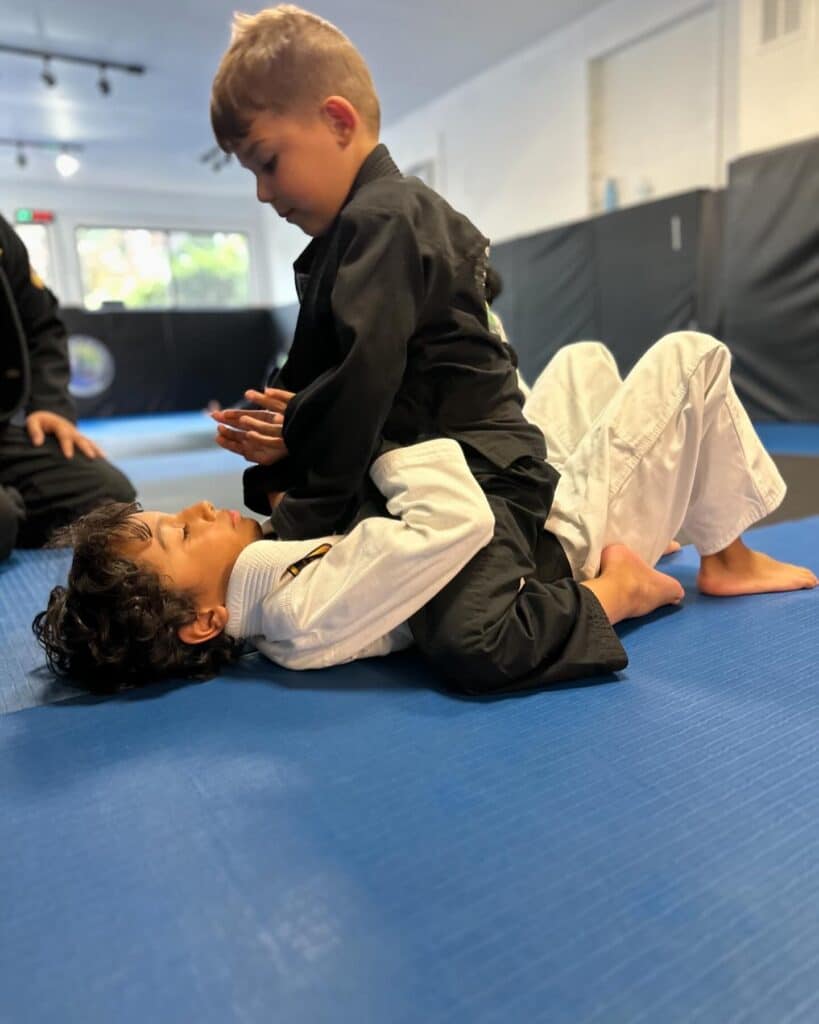
Movement and routine would be enough for an afternoon, but kids also leave with a skill that is actually theirs. Each class teaches one technique, broken into small, clear steps in simple language, then practiced with a partner their own age and size while a coach watches every group. Week by week the pieces stack: how to fall safely, how to escape from underneath, how to control a position, and the tap — the signal that stops any exchange instantly — learned from the very beginning. Progress is marked the way we explain in how kids’ belts and stripes work: stripes and belts are the coach’s decision, based on attendance, attitude, and skill over time. Which means the confidence parents talk about has a specific source — a child can do in month three what they could not do in week one, and they know it, because they did it.
The same friends, every week
Jiu-jitsu is practiced with partners, so an after-school class is also social time with a job to do. The same group shows up on the same afternoons, partners rotate, and every drill asks two kids to cooperate — to communicate, take turns, and look out for the person across from them. For our youngest students, Little Grapplers ages 4–6, that happens through movement, games, and play built for their age. For kids ages 7–12 it happens inside real technique at their level. Either way, children are grouped by age and size, so the friends they make are their own age — and teenagers, ages 13–17, are not in the room at all; they train in their own class at 6:00 PM. The full picture of the program is on our kids jiu-jitsu page.
An hour with a clear beginning and end
There is a practical benefit parents mention as often as any other: the hour is bounded. Class starts at 5:00, ends at 5:45, and contains no screens and no waiting around — your child is occupied, supervised, and moving for all of it. That predictability is what lets a family build an afternoon around it: school, a snack, class, home. Older kids, ages 10–12, who want more mat time can also stay for a second session at 6:00 PM on the same evenings, and families whose weekdays are full use the Saturday 9:00 AM class for younger and smaller kids instead. One slot, the same every week, is easier for a child to settle into than a rotating schedule of one-off activities.
What it is not — the honest limits
Three honest limits, because parents deserve them before they book anything. First, this is a class, not childcare: WDC BJJ is a martial arts academy, there is no school pickup or transportation, and families bring their children to us. We are asking Takoma Park families whether a fuller after-school program — class plus supervised homework time — would help them, and the interest list is on our after-school page. Second, a class practices focus, listening, and follow-through; it does not treat anything, and no honest program should claim otherwise. Third, none of it is instant: what a child gets out of BJJ comes from showing up regularly over weeks, the same way any skill or routine is built. Families who expect that tend to be the ones who see the most in it.
If you want to see what your child gets out of it, the honest way is to watch them in a real class. A first class at WDC BJJ is free — a real group class with their own age group, at 5:00 PM on a weekday or 9:00 AM on Saturday — and parents watch from the side of the mat, so you see everything we do. Book a free class, and afterwards we walk you through how the program works and answer every question, with zero pressure.
Your first class is free.
A real group class with your own group. No experience needed, no payment, no contract for a trial — and enrollment includes a free uniform.
1. Send the free-trial request or call (202) 636-3453.
2. We confirm the right class for your age and schedule.
3. Arrive 15 minutes early in athletic clothes with water.
4. Train a real class — then decide with zero pressure.
BJJ after school, answered
It fits the after-school hours well: kids' classes at WDC BJJ run Monday through Thursday at 5:00–5:45 PM for ages 4–12, grouped by age and size. In 45 minutes a child gets real movement after a day of sitting, one technique taught in small steps, and supervised practice with partners their own age and size — then class ends on time, and the evening is still free for dinner and homework.
Every class follows the same rhythm. It opens with movement and games that build balance, coordination, and listening skills. Then the coach teaches one technique in small, clear steps, and kids practice it with a partner their own age and size while a coach watches every group. Class finishes with mat time that teaches respect, patience, and cooperation. Children learn the tap — the signal that stops any exchange instantly — from the beginning.
Our kids program serves ages 4–12. The youngest group, Little Grapplers, is ages 4–6, where learning happens through movement, games, and play. Kids ages 7–12 learn real technique at their level in the same 5:00 PM classes, and everyone is grouped by age and size — no child trains against a much bigger partner. Older kids, ages 10–12, can also join a second session at 6:00 PM, Monday through Thursday. Teenagers, ages 13–17, have their own separate class at 6:00 PM.
No. WDC BJJ is a martial arts academy, not a childcare provider, and there is no school pickup or transportation — families bring their children to us at 720 Erie Ave in Takoma Park, where we have our own parking lot. What runs today is the class itself. We are separately asking Takoma Park families whether a fuller after-school program — class plus supervised homework time — would help them; that interest list lives on our after-school page.
Send the free-trial request or call (202) 636-3453, and we will confirm the right class for your child's age and your schedule. Arrive 15 minutes early in comfortable athletic clothes — no pockets or zippers — with a water bottle, and check in at the door. Your child trains a real group class with their own age group; there is no payment and no contract for a trial. Afterwards we walk you through how the program works and answer every question, with zero pressure. If you decide to enroll, the uniform is included free.