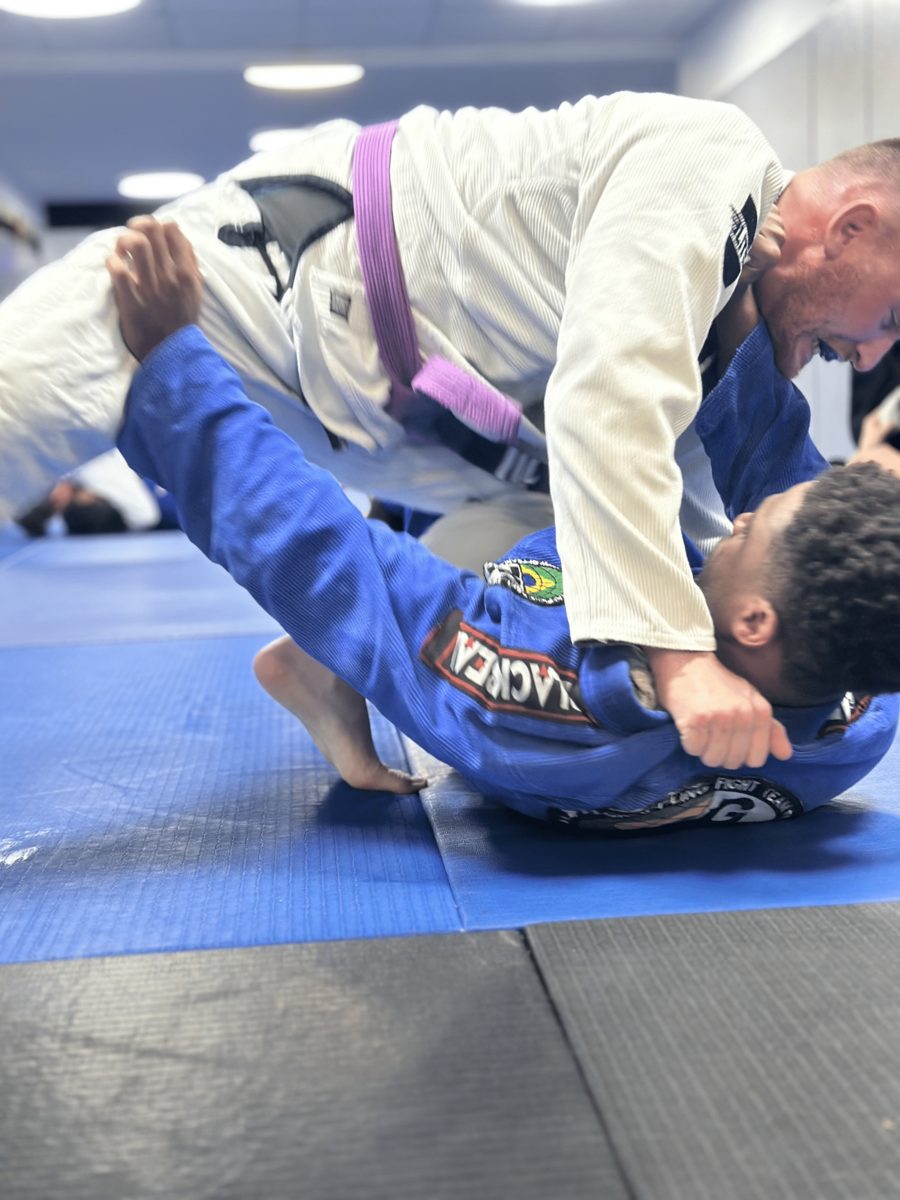
Starting Brazilian Jiu-Jitsu as an Adult Beginner in Takoma Park: What Your First Month Actually Looks Like
No experience, no uniform, no being thrown to the wolves — how the first class works, how gi and no-gi differ, and what progress honestly looks like in your first month.
Almost every adult who starts Brazilian jiu-jitsu at WDC BJJ walks in with the same three worries: Am I too old or too out of shape for this? Will I get hurt? Will everyone else already be good? They are fair questions — most of our adult students had never done a martial art before their first class, and plenty started in their thirties, forties, and beyond. This guide walks through what your first class is actually like at our academy, how gi and no-gi training differ for a beginner, and what progress honestly looks like across your first month — no hype, and no miracles promised.
WDC BJJ is a family-owned Brazilian jiu-jitsu academy at 720 Erie Ave, Takoma Park, MD 20912, part of this neighborhood since 2015 and part of GFTeam, one of the most respected jiu-jitsu teams in the world. Our beginner adult program is built for people starting from zero: you train in real classes with our regular students, but everything in your first month is paced, partnered, and supervised with a true beginner in mind.
Your first class, step by step
Your first class is a free trial — a real class, not a tour and not a sales pitch. Arrive about 15 minutes early. The academy has free parking in its own lot, so there is no circling the block; park, come in, check in at the door, and meet the coach running the session. Tell them it is your first class — that one sentence changes everything about how your hour is set up.
You do not need a uniform. Wear comfortable athletic clothes (no pockets or zippers) and bring a water bottle. If you would like to train in the traditional uniform, the gym keeps loaner gis for trial students — just ask when you arrive. Class begins with a warm-up built around jiu-jitsu movements, then the coach teaches one technique in small steps and you drill it with a partner, taking turns. New students are paired thoughtfully, and the room runs on one rule above all others: tapping out stops everything, instantly, every time. Live practice rounds are supervised and always optional — plenty of first-timers watch a round or two before joining in, and nobody is thrown in against an experienced student to "test" them.
Gi or no-gi — where should a beginner start?
Gi training uses the traditional uniform; partners can grip collars and sleeves, which slows the action down and makes it very technical. No-gi training is done in athletic clothing — usually a rash guard and shorts or leggings — and tends to move faster, with grips on wrists, arms, and body position instead of cloth. The positions and escapes underneath are the same art; the handles are different.
For a complete beginner, either door works, and most of our students end up training a mix of both. If you picture yourself in the traditional uniform, start with a gi class. If you would rather begin in the athletic clothes you already own, our schedule includes beginner-friendly no-gi sessions — including Tuesday evenings — where the pace and the material are set with new students in mind. Either way, new students are coached by Professor Deivid's coaching team, and either way your first class is free — so the lowest-pressure move is to try one of each in your first two weeks and see which one pulls you back.
Class times that fit a working life
Adults train at three kinds of times at WDC BJJ. Morning classes run at 7:00 AM on Tuesday, Wednesday, and Thursday — in and out before work. Evening classes run at 6:00 PM and 7:00 PM, Monday through Thursday, and Friday has a 6:00 PM class to close the week. Two classes a week is the pace we recommend for a beginner: enough repetition for techniques to start sticking, and enough rest between sessions for your body to adapt. Our full class schedule lists every program we run, including the women's-only and advanced sessions you can grow into.
What your first month honestly looks like
Week one is orientation disguised as exercise. You will learn how to fall safely, how to tap, the names of the main positions, and one or two escapes. You will be sore in places you did not know you had — that is normal, and it fades fast. In weeks two and three, the warm-up stops feeling foreign, your conditioning starts catching up, and a couple of the escapes begin to connect: a partner holds you down, and instead of just pushing, you remember a frame, a hip movement, a way out. By week four, you will not feel lost anymore. You will still be tapped — regularly — by students with months or years on you. That is not failure; that is the sport working exactly as it should, and it is also how you learn.
What a month will not do is make you "good at jiu-jitsu," and any school that promises that in thirty days is selling something. Belts and stripes are earned over a much longer road. What one honest month gives you is real: a base of movement, a few techniques your body actually remembers, better conditioning, and a clear answer to the only question that matters — whether this is a room you want to keep showing up to. For most people who try it, it is.
Who teaches you
Classes at WDC BJJ are led by Professor Deivid Dias and his coaching team. Professor Deivid is a GFTeam black belt in the Fadda lineage — the line that runs from Maeda through Luiz França and Oswaldo Fadda, on through Monir Salomão and GFTeam founder Júlio César Pereira, to Deivid's own professor, Ataíde Rafael — and a decorated IBJJF competitor, with Pan American and American National titles. What that means for a beginner is simpler than the pedigree sounds: the technique you learn in week one is the real thing, taught in small steps, with the details that make it work against someone bigger — because leverage over strength is the founding idea of this lineage.
The coaching culture follows from that: patient with beginners, serious about safety, and allergic to ego. Experienced students are expected to look after new ones. That is the room you are walking into.
How to start
Starting takes one step: book a free trial class or call us at (202) 636-3453. Pick a morning or evening session, arrive 15 minutes early in athletic clothes with a water bottle, and train. No payment and no contract are involved in a trial. If you decide to enroll afterward, enrollment includes a free uniform — so the gi question answers itself, and your first month can begin.
Your first class is free.
A real adult class with Professor Deivid's coaching team and our regular students. No experience needed, no payment, no contract for a trial — and enrollment includes a free uniform.
1. Send the free-trial request or call (202) 636-3453.
2. Pick a session: 7 AM Tue–Thu, 6 or 7 PM Mon–Thu, or Fri 6 PM.
3. Arrive 15 minutes early in athletic clothes with water — loaner gis are available.
4. Train a real class — then decide with zero pressure.