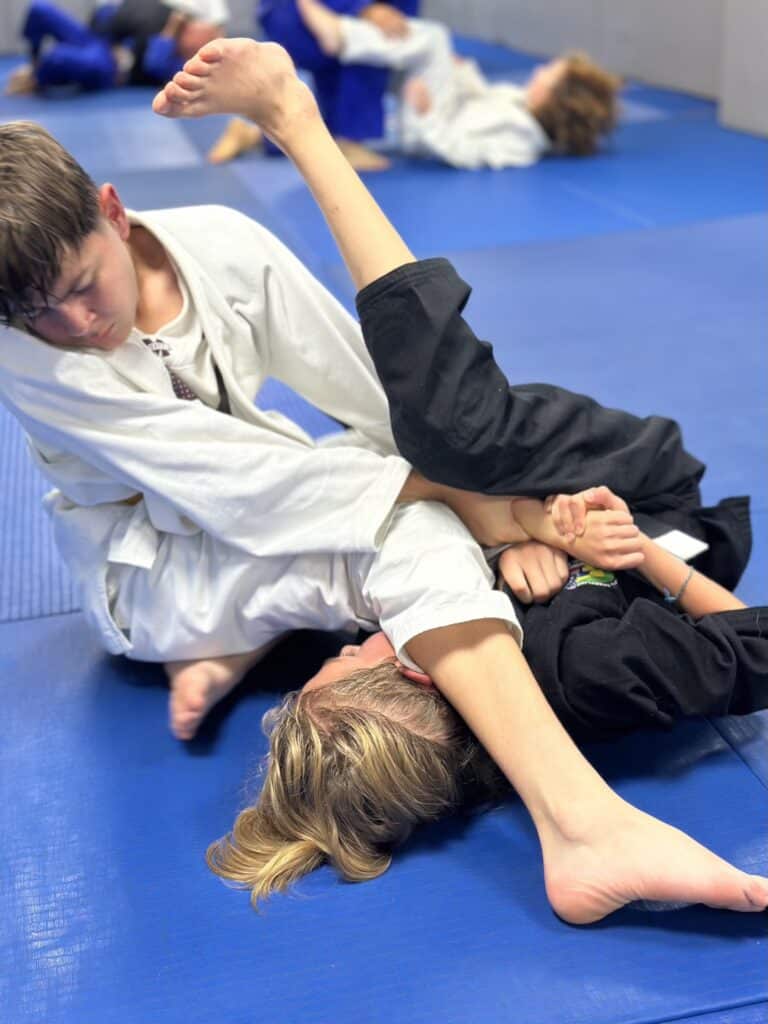
BJJ for Kids With Lots of Energy: Channeling It on the Mat
Some kids are not built to sit still — and a good class does not ask them to. Here is how our 45-minute kids’ classes spend big energy on purpose: movement first, structure always, and a coach watching every pair.
Every parent of a high-energy kid knows the pattern. They are climbing the couch by 8 AM, bouncing through homework, and somehow still wide awake at bedtime. School asks them to sit still for hours; by the time the last bell rings, that energy has nowhere to go. Jiu-jitsu works for these kids not by draining them like a battery, but by giving the energy a job. At WDC BJJ in Takoma Park, our kids’ classes run 5:00–5:45 PM, Monday through Thursday, for ages 4–12 — and almost every minute of those 45 minutes is spent moving. This page explains how a class is built, how we keep fast-moving kids safe around each other, and what the structure of the room does with all that energy.
A class that barely sits down
The first thing parents notice is how little sitting there is. Class opens with movement — running, crawling, rolling, and games that build balance and coordination. Then the coach teaches one technique, in small steps and simple language, and kids practice it right away with a partner instead of watching a long demonstration. There are short pauses to listen, line up, and reset — and then it is back to moving. A high-energy child is never asked to hold still for twenty minutes and behave; they are asked to listen for thirty seconds, try the movement, and go again. For a lot of big-energy kids, that rhythm is the first time a structured activity has actually matched how they are wired. You can see the full week on our class schedule.
Structure is what channels it
Energy without structure is chaos; energy with structure becomes practice. The channeling happens through the same routines every class: bow in, line up by group, listen for the coach’s steps, take your turn, treat your partner well, reset. The rules are few, consistent, and physical — hold your partner safely, stop the instant anyone taps, wait for your turn on the drill. Kids learn to aim their effort: full speed on the warm-up lap, controlled pressure on the technique, careful hands with a smaller partner. That is not a medical program and we are not therapists — it is a physical class with clear structure, taught the same way every day, and the structure itself is what gives busy kids something solid to push against.
Partners are matched — nobody gets bowled over
Parents of energetic kids usually ask the same worried question from the other side: will mine be too much for the other children? The answer is in how the room is run. Children are grouped by age and size, from Little Grapplers (ages 4–6, where learning happens through movement and games) up through the 7–12 group. Partners are a fair match, a coach watches every group during practice, and the tap — the signal that stops any exchange instantly — is taught from the very first class and obeyed without exception. A child who goes too hard gets slowed down, re-matched, and coached through it, the same as any other skill. The whole program is laid out on our kids jiu-jitsu page.
The first day is built for the wiggly kid
A first class is not a test your child can fail. New students get the buddy system: a friendly, experienced student their own size who knows it is their first day and shows them where to stand, when to line up, and what comes next. The coach learns your child’s name in the first few minutes, and nobody is put on the spot in front of the room. You watch everything from the side of the mats. If your child needs a breather at the edge of the mat for a minute, that is fine — it happens, and it is handled without a fuss. Most high-energy kids do not need to be calmed down before class; they need a class that was expecting them.
What parents tell us they notice
We are careful here, because no honest coach promises a child will change. What parents say to us, in their own words at the door, is simpler: the ride home is calmer, the evening routine is easier to land, and their child talks about class all week. Inside the room, the changes we can actually watch are concrete — a child who could not wait his turn in week one is holding a drill line in week six; a girl who bounced through every instruction is listening for the coach’s steps before she moves. Focus, coordination, and follow-through are trained here the way they are trained anywhere: by practicing them, in small steps, with the same group every week.
If your child has energy to spare, bring it to a free first class. It is a real group class in their own age group — 5:00 PM on a weekday, or the 9:00 AM Saturday class for younger and smaller kids. Your child trains, you watch from the side of the mat, and afterwards we walk you through how the program works and answer every question. Book a free class, or read exactly what a first visit looks like in our first-class guide — then decide with zero pressure.
Your first class is free.
A real class with their own age group — movement first, structure always. No experience needed, no payment, no contract for a trial — and enrollment includes a free uniform.
1. Send the free-trial request or call (202) 636-3453.
2. We confirm the right class for your age and schedule.
3. Arrive 15 minutes early in athletic clothes with water.
4. Train a real class — then decide with zero pressure.
Kids with big energy, answered
Usually, yes — because the class barely asks them to. A kids' class at WDC BJJ is 45 minutes of near-constant movement: warm-up games, one technique taught in small steps, then partner practice. Listening happens in short bursts between moving, not in long stretches. The structure — lining up, taking turns, following the coach's steps — is practiced physically, the same way every class, which suits kids who learn by doing.
No. There are short moments to line up and listen while the coach shows a step, and then kids are moving again. Coaches teach in simple language and small steps sized for the age group. A child who needs a short breather at the side of the mat can take one — it happens, and it is handled without a fuss.
Safety here is structure. Children are grouped by age and size, partners are a fair match, and a coach watches every group during practice. Every child learns the tap — the signal that stops any exchange instantly — from the first class, and it is obeyed without exception. A child who goes too hard is slowed down, re-matched, and coached through it.
You do not have to wait for your child to become gentle before starting — learning control is part of what class teaches. Partners are matched by size, practice is supervised the whole time, and the rules about treating partners well are few, clear, and enforced the same way every day. Tell us about your child when you book, and the coach will know what to watch for on day one.
Kids ages 4–12 train Monday through Thursday at 5:00–5:45 PM, grouped by age and size — gi on Monday, Wednesday, and Thursday, and no-gi on Tuesday. Little Grapplers, ages 4–6, learn through movement and games in the same classes. On Saturday, the 9:00 AM class is for younger and smaller kids. Teenagers, ages 13–17, have their own class at 6:00 PM.
Send the free-trial request or call (202) 636-3453, and we will confirm the right class for your child's age. Arrive 15 minutes early in comfortable athletic clothes — no pockets or zippers — with a water bottle, and check in at the door. Your child trains a real group class with the buddy system, and you watch from the side of the mats. There is no payment and no contract for a trial; if you decide to enroll, the uniform is included free.