How Brazilian Jiu-Jitsu Helps Kids Stand Up to Bullying
Not by teaching your child to fight — by changing how they carry themselves into the hallway. Posture, a clear voice, calm under pressure, and a room full of people in their corner.
Almost every parent who comes to our academy in Takoma Park about bullying starts the same way: “I just don’t know what to do anymore.” They say it quietly, at the door, while their child looks at the mats. If that is where you are, this page is for you — because the helpless feeling is the worst part of bullying, for the child living it and for the parent watching it happen.
What bullying actually looks like now
Forget the cartoon version — one big kid waiting by the bikes. Most bullying today is smaller and harder to point at. It is the group chat your child is not in. The lunch seat that is suddenly “saved.” The nickname that follows them down the hallway. The rumor moving phone to phone. Sometimes it is physical — a shove where no teacher is looking, a backpack grabbed on the bus — but a lot of it is social and repeated, designed to make one kid feel alone. And it follows them home now: the school day ends, the phone lights up. Parents feel helpless for a simple reason: you cannot be there. You cannot stand in the hallway or sit at the lunch table. Talking to the school matters, and you should do it — but between meetings, your child still walks those hallways on their own. What they carry into those moments is the part you can actually change.
Bullies choose targets — and training changes the target
Here is the part nobody tells parents: bullying is usually a selection process. A bully tests the room — a comment here, a bump there — and watches who shrinks. The kids who get picked again are the ones who look unsure of themselves: shoulders down, eyes on the floor, voice small, quick to fold. It is rarely about size. A small kid with steady eyes gets left alone; a bigger kid who looks lost gets picked. Jiu-jitsu changes what a bully sees. A child who trains stands differently — head up, shoulders back — not because anyone taught them a pose, but because their body knows something true: if this gets physical, I know what to do. They make eye contact. They answer in a clear voice. They do not flinch at the test. Most of the time, that is where it ends — the bully goes looking for an easier day.
Confidence that is earned, not handed out
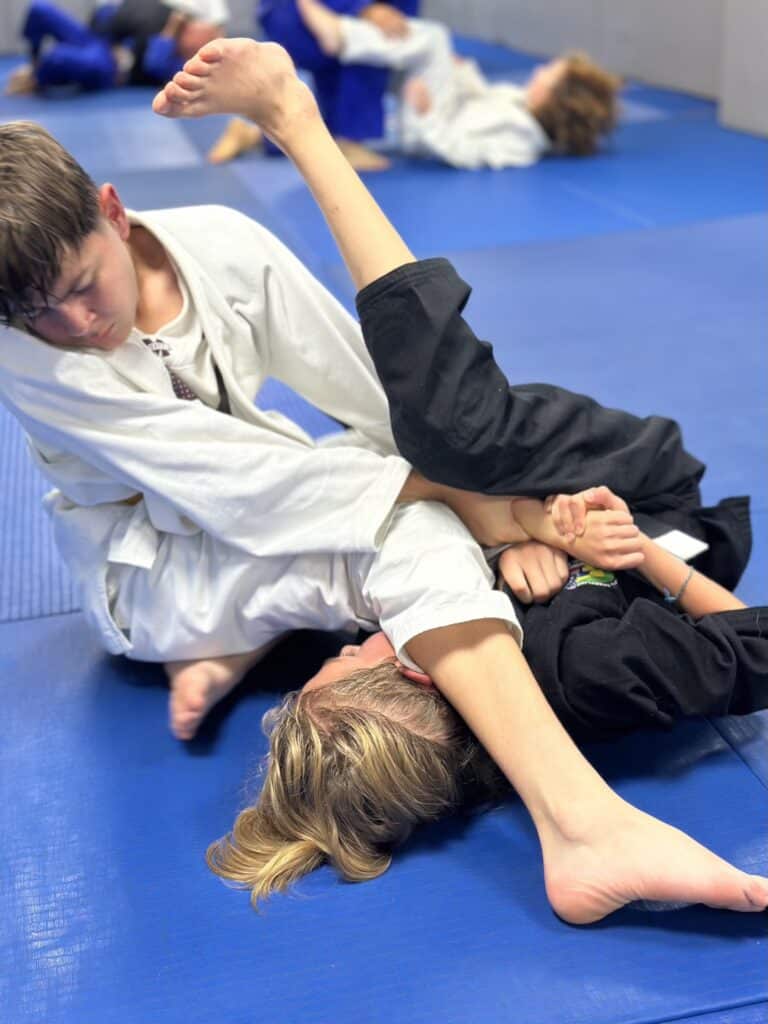
There is a difference between telling a child “you are strong” and a child knowing it. On our mats, kids train against partners who are genuinely resisting — trying to hold them down, trying to escape. When a smaller kid escapes from underneath a bigger partner for the first time, nobody has to convince them it happened. They felt it. That is confidence built out of evidence, and it is the only kind that survives a school hallway. Nothing here is given away: stripes and belts are earned slowly, in front of everyone, for attendance, attitude, and skill. A child who has earned something real walks like it. Kids can tell the difference between praise and proof — and so can the kid testing them at school.
Control, not fighting
Parents ask us, reasonably: “I don’t want my child fighting at school.” Neither do we. Jiu-jitsu is the wrong art for fighting and the right art for control — there is no punching or kicking in what we teach kids. The order we teach is words first, always: stand tall, use a strong, clear voice — “Stop. I don’t like that.” — then walk away and tell an adult. The physical skills are the last resort, and they are built for one job: stay safe without hurting anyone. A child learns to escape from underneath, to get on top, and to pin and hold a bigger person still until the moment passes or help arrives. No strikes. Nobody gets hurt in the cafeteria. And here is the honest truth coaches see season after season: the kids who have those skills almost never use them, because the confrontation usually stops at the posture and the voice. The skill is the reason they don’t need the skill.
Discipline, respect, and a room that has their back
A child being bullied often feels like they belong nowhere. Our academy is built to be the opposite of that. WDC BJJ is family-owned, and our coaches know every kid on the mats by name — what they are working on, who their friends are, and when something seems off. Kids bow in, listen, take care of their partners, and learn that the most respected person in the room is usually the most controlled one. They train next to teammates who cheer for them on promotion day and notice when they are quiet. A kid who belongs somewhere — who has a whole room in their corner — carries that into school with them. Belonging is not a small thing. For a bullied kid, it can be the whole thing. You can see how the program runs on our kids jiu-jitsu page, and our guide to standing up without fighting goes step by step through what kids practice.
Come watch a class first
You do not have to take our word for any of this. Come sit at the side of the mats at 720 Erie Ave in Takoma Park and watch a kids class — watch the posture, the listening, the way the older kids take care of the smaller ones. If it looks right for your child, their first class is free: a real group class with kids their age, no payment and no contract for a trial, and a free uniform if they enroll. Send the free trial request or call (202) 636-3453 and we will find the right class — kids train at 5:00 PM on weekdays, in age groups from 4 to 12, and teens have their own class. Your child does not have to dread the school week. Let’s change what they carry into the hallway.
Your first class is free.
A real group class with your own group. No experience needed, no payment, no contract for a trial — and enrollment includes a free uniform.
1. Send the free-trial request or call (202) 636-3453.
2. We confirm the right class for your age and schedule.
3. Arrive 15 minutes early in athletic clothes with water.
4. Train a real class — then decide with zero pressure.
Bullying and jiu-jitsu, answered
No — and the structure of class prevents it. Kids here learn that their partner's safety is their job: when a partner taps, everything stops, instantly. Control is the skill we praise; hurting a partner or showing off is never tolerated. Children who train feel real resistance every class, so they know exactly what a real fight costs — and that knowledge makes them slower to fight, not quicker. What changes is not aggression. It is calm.
Words first, always: stand tall, use a strong, clear voice — “Stop. I don't like that.” — then walk away and tell an adult. If it still gets physical, the jiu-jitsu answer is escape and control: get out from underneath, get on top, and hold the other child still without striking or hurting them, until an adult steps in or the moment passes. There is no punching or kicking in kids' jiu-jitsu. The goal is never to win a fight. The goal is to end one safely.
Honestly, there is no honest date — be suspicious of anyone who gives you one. Skill takes months and years, like any real skill. What tends to change first is smaller: posture, a little more eye contact, a kid who stands straighter because class is a place where they succeed at hard things. The deeper calm — the kind a bully notices — builds as the skill becomes real. Consistency is what does it: two or three classes a week, kept up.
Kids ages 4 to 12 train in age groups at 5:00 PM, Monday through Friday — our youngest, ages 4 to 6, are the Little Grapplers — and Saturday has a 9:00 AM kids no-gi class. Teens 13 to 17 have their own dedicated class, because a fourteen-year-old is not a big kid. Partners are matched by size and experience, and coaches are on the mats for the whole class.
Send the free-trial request or call (202) 636-3453, and we will confirm the right class for your child's age. Arrive about 15 minutes early in comfortable athletic clothes with a water bottle — no uniform or equipment is needed to try. Your child joins a real group class, and you are welcome to watch from the side the whole time. There is no payment and no contract for a trial, and if you decide to enroll, the uniform is included free.