BJJ vs. the Gym: Why People Quit the Treadmill and Start Jiu-Jitsu
Nobody falls in love with a treadmill. People quit gyms because the workout has no point beyond itself — and start jiu-jitsu because every session teaches them something, with people who notice when they don’t show up.
January is our favorite month to watch the big gyms fill up — and March is when we meet their refugees. The story is always the same. Someone bought a membership with real intentions, went faithfully for five or six weeks, and then slowly stopped, not because they got lazy but because the treadmill is a hard thing to love. Running in place, watching a screen, counting down minutes: the workout demanded willpower every single day and gave nothing back but a number. If that cycle sounds familiar, the honest conclusion is not that you lack discipline. It is that you were given an exercise format with no skill in it, no people in it, and no reason to return except guilt. Jiu-jitsu is built out of the three things the gym is missing.
A workout that teaches you something
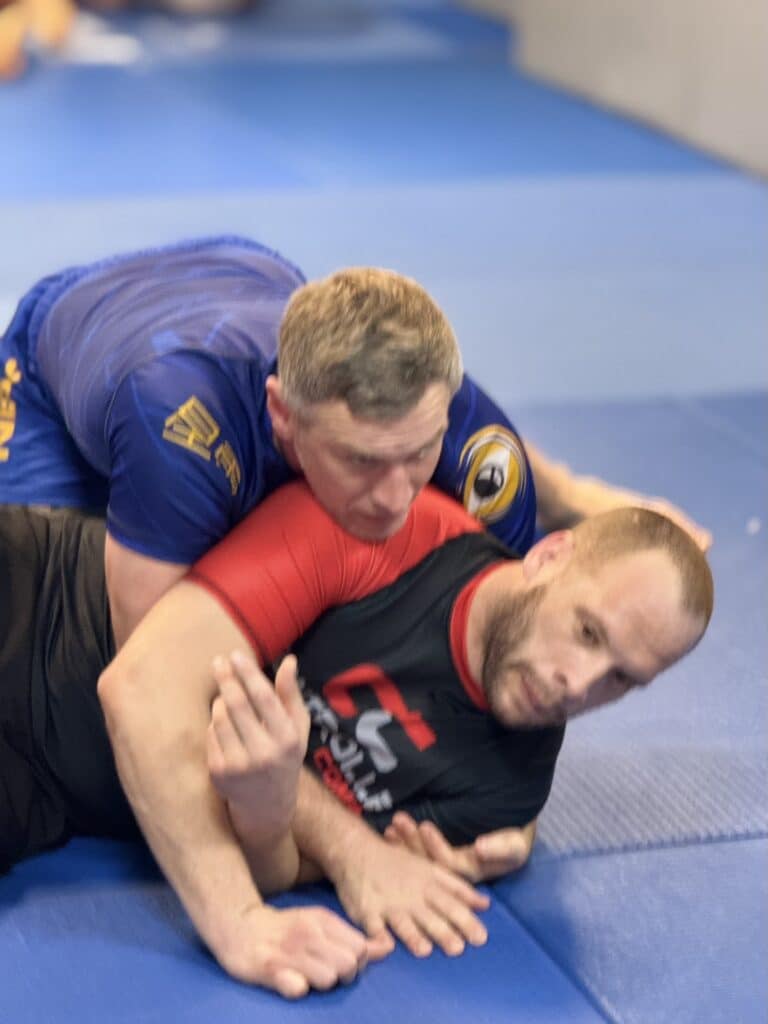
Here is the deepest difference: at a gym, exercise is the product. In jiu-jitsu, exercise is the byproduct. You come to class to learn how to escape from underneath a bigger person, how to control a position, how a choke actually works — and the conditioning happens incidentally, because grappling is whole-body work: pushing, pulling, carrying weight, moving on the ground, gripping, bridging, standing back up. Students who hated “cardio” discover they will happily do an hour of it when it is disguised as a problem to solve. And unlike a treadmill program, progress here is a skill you keep. Nobody can repossess your ability to fall safely or defend yourself. A year at the gym leaves you with a year of attendance. A year on the mats leaves you with a craft.
People notice when you don’t show up
The gym is anonymous by design — thousands of members, most of whom will never learn each other’s names, which means nobody notices when one of them quietly stops coming. That anonymity is exactly why quitting is so easy. An academy runs the other way. You train with the same partners every week. They know your name, your game, and your usual class days — and when you miss a week, somebody asks where you were. That light social accountability does more for consistency than any amount of self-discipline. Showing up becomes the default because people expect you, the way they expect a teammate. WDC BJJ is family-owned and small enough that this is structural, not a slogan: the community is the retention program, for us and for your fitness alike.
What the training actually does to a body
Let’s be concrete about the physical side, without inventing numbers. Grappling works muscles in combinations no machine row reproduces — grip and forearms, back and hips, legs driving and posting, a core that is working every second you are on the ground. Rounds alternate effort and recovery the way interval training does, except the intervals are set by a live partner instead of a timer. Students typically find their wind, their strength, and their posture all change over the first months, and the soreness of the early weeks is the honest price of a body being asked to do real things again. One of our students, Junior, lost over 120 pounds over his years on these mats — his story is on this blog, and it started with him being exactly where a lot of gym-quitters are. The difference was not his willpower. It was the format.
The honest case for the gym — and the real comparison
Fairness matters: a conventional gym is cheaper per month, open more hours, and better if your goal is specifically to build maximum muscle or train for a lifting goal. If you love lifting, lift — some of our students do both. But be honest about what you are comparing. The relevant comparison is not jiu-jitsu versus the gym you attend; it is jiu-jitsu versus the gym you stopped attending by March, which delivers no fitness at all. The best workout is the one still happening in month six. Training that teaches a skill, inside a community, at a set time, with people expecting you — that is a format engineered to still be happening. Our beginner program assumes you are starting from the couch, the desk, or the cancelled membership.
Trade one week of treadmill for one class
Do not take our word for it — run the experiment. Your first class is free: a real group class, no payment and no contract for a trial, and a free uniform if you enroll. Adults train at 7:00 AM Tuesday, Wednesday, and Thursday, and in the evenings through the week — Thursday has 6:00 PM gi and 7:00 PM no-gi, Friday 6:00 PM is all levels, and Saturday’s 10:00 AM open mat is the social one. Arrive 15 minutes early in athletic clothes with a water bottle. Send the free trial request or call (202) 636-3453. If you have a gym membership gathering dust, you already know how that story ends. Come see how this one starts.
Your first class is free.
A real group class with your own group. No experience needed, no payment, no contract for a trial — and enrollment includes a free uniform.
1. Send the free-trial request or call (202) 636-3453.
2. We confirm the right class for your age and schedule.
3. Arrive 15 minutes early in athletic clothes with water.
4. Train a real class — then decide with zero pressure.
BJJ vs. the gym, answered
Both, in that order of appearance. Early classes are technique-heavy while you learn, and even then drilling is physical work. As you progress, live rounds are full-body, interval-style effort — gripping, pushing, carrying a partner’s weight, getting up off the ground repeatedly. Students are reliably surprised by how winded a six-minute round leaves them.
If maximum muscle is the goal, lifting is the direct tool — we will not pretend otherwise. Jiu-jitsu builds functional strength, grip, and conditioning, and plenty of students lift alongside training. The question to answer honestly is which one you will still be doing in six months. A program you keep beats a perfect program you quit.
Two things: a skill and a community. A fitness class burns the hour and ends; a jiu-jitsu class adds to something you are building, with partners who train with you every week and notice your progress and your absence. The workout is comparable. The reasons to return are not.
Because the failure mode of those programs is built into their design — solitary, repetitive, and pointless-feeling by week five. Training here is social, varied, and visibly progressive: new techniques, stripes, and partners who expect you. We cannot promise you will stick with it. We can say the format removes the three reasons most people quit.
Send the free-trial request or call (202) 636-3453, and we will confirm the right class for your schedule. Arrive about 15 minutes early in athletic clothes with a water bottle — no uniform needed to try. You join a real group class, with no payment and no contract for a trial. If you enroll, the uniform is included free.