Bullyproof: Standing Up Without Fighting
Most bullying is stopped before anyone throws a punch — by posture, a clear voice, and an adult looped in early. Here is what our kids in Takoma Park actually practice, and the honest limits of what any class can promise.
When parents in Takoma Park ask us about bullying, they are rarely asking for a fighting class. They are asking a quieter question: if my child is ever cornered, teased, or grabbed in a hallway, will they freeze — or will they know what to do? At WDC BJJ, our answer is a program parents often call bullyproof, and it has very little to do with fighting. It starts with how a child stands, speaks, and carries themselves; it adds words and boundaries, practiced out loud; and only at the very end, as a last resort, does it add physical skill — grappling-based, with no striking at all: control the moment, calm it down, let go, and get to an adult. This guide walks through each layer honestly, including what no class — ours included — can promise.
Why confidence and posture come first
Most bullying is selection before it is confrontation. A child who walks with their head down, avoids eye contact, and shrinks from attention is an easier target than a child who stands tall, looks people in the eye, and answers in a clear voice — and children who pick on others can tell the difference at a glance. Training works on exactly that layer, every week. Kids line up, stand ready, drill with partners, and do hard things in small steps in front of the same friendly group — and over time that shows up off the mat as posture, eye contact, and a voice that carries. None of this is a guarantee; no honest program can promise your child will never be picked on. But the first and most-used self-defense a trained child owns is simply being harder to choose.
Words first: boundaries and getting an adult involved
The second layer is verbal, and it is the one most children will actually use. A boundary said early and said clearly — a loud, firm “Stop,” “That’s not okay,” or “Leave me alone” — changes a moment: it draws the attention of everyone nearby, and it tells the other child this will not be quiet or easy. But a boundary only works if a child can say it under pressure, which is why it has to be practiced out loud, not just explained at the dinner table. And the rule that sits behind every boundary is the most important one we teach: get an adult involved. Walking toward people, telling a teacher, and telling a parent is not weakness or tattling — it is the strategy. Most real situations a child faces end because an adult got involved early, and our self-defense teaching puts awareness, voice, and boundaries first for exactly that reason.
The last resort: control and escape, never striking
Only if words fail and a situation turns physical does the third layer matter — and it is deliberately un-dramatic. There is no striking in Brazilian jiu-jitsu: children do not learn to punch or kick a classmate, and a smaller child’s realistic goal is never to out-hit someone bigger. What they learn instead is grappling: how to fall safely so a push is not an injury, how to break free of a wrist grab or a bear hug, how to protect themselves if they are taken to the ground, and how to hold and control a position calmly — without hurting the other child — until the moment passes, then let go and get to safety and help. Hold, control, calm, let go. It is a principle a child can use without becoming the aggressor, and it is the same one behind everything on our what actually works in kids’ self-defense guide.
What kids actually practice in class
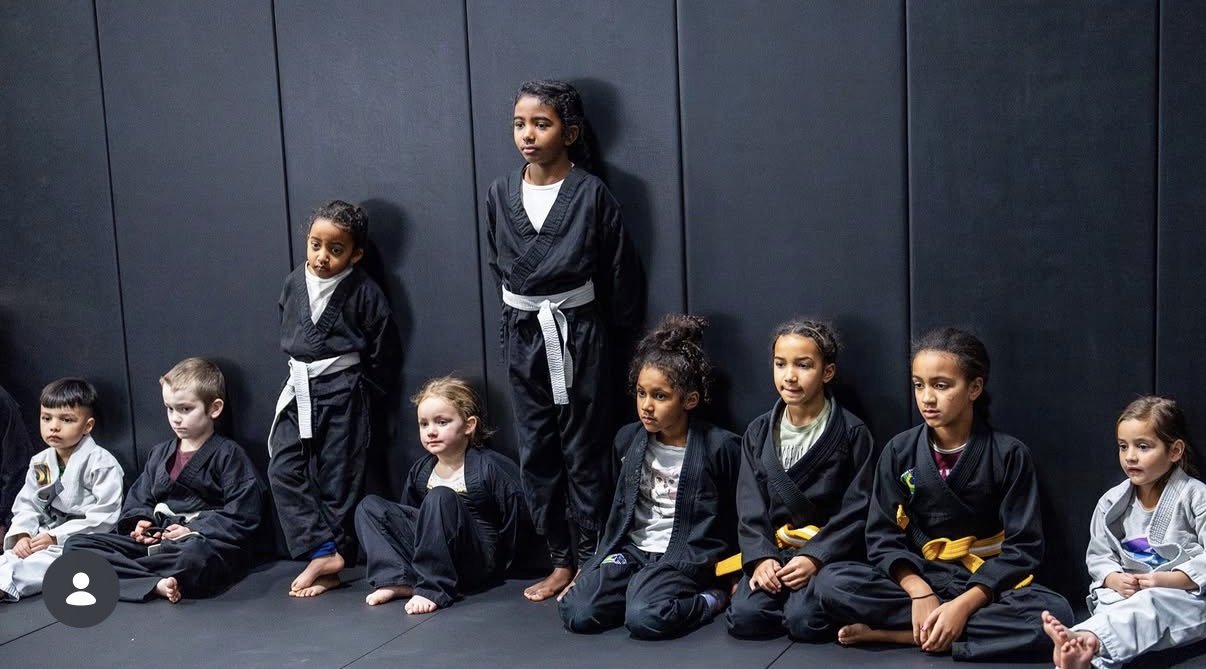
None of this is a lecture — it is the ordinary curriculum of our kids jiu-jitsu classes, repeated until it becomes reaction. Breakfalls: falling and rolling safely, so being pushed or tripped does not mean being hurt. Positional control: holding a partner in place with balance and leverage, and escaping from underneath someone holding them down. Staying calm under pressure: breathing, framing, and thinking while a partner leans real weight on them, instead of panicking. And woven through all of it, the tap — learned on day one — the signal that stops any exchange instantly. A room where every child can stop anything, at any time, and be obeyed immediately is a room that teaches both halves of standing up for yourself: how to act, and how to say stop. Partners are always matched by age and size, and a coach chooses every pairing and watches every group.
How it shows up at school
Parents usually report the school changes before they mention anything physical. Eye contact when a teacher speaks. A voice that answers questions out loud instead of barely being heard. Walking into a room tall instead of apologizing for being in it. Those are the visible edges of the same work: hundreds of small repetitions of standing ready, being looked at, trying something hard, and being fine. We are careful about the claim here: training does not rewrite a child’s personality, and a shy child is not a problem to be fixed — our guide to jiu-jitsu for shy kids is honest about that. What consistent training does is give a child proof, earned on the mat, that they can handle an uncomfortable moment — and children who have that proof tend to carry it into the hallway, the cafeteria, and the bus line.
If your child reports bullying: a note for parents
Finally, the layer that belongs to you. If your child tells you they are being bullied, the first move is to listen and believe them — reporting it is the hardest part, and they just did it. Write down what happened while it is fresh, and tell the school: teachers and counselors cannot act on what they do not know. Keep your child’s routines steady — school, activities, training — because confidence is built on consistency, not on being pulled out of everything that feels hard. And tell their coaches, so the adults around your child are watching the same things you are. If anything ever feels genuinely unsafe, involve the school and, where needed, other authorities right away rather than waiting it out. Your child’s job is to speak up early; yours is to make sure speaking up works.
The honest test of all of this is one real class, watched with your own eyes. A child’s first class at WDC BJJ is free — a real group class with their own age group, you watching from the side of the mat, and no payment or contract for a trial. Watch how your child stands, speaks, practices an escape, and learns how to fall and how to stop. Book a free class, or read exactly what a first visit looks like in our first-class guide — then decide with zero pressure.
Your first class is free.
A real group class with your own group. No experience needed, no payment, no contract for a trial — and enrollment includes a free uniform.
1. Send the free-trial request or call (202) 636-3453.
2. We confirm the right class for your age and schedule.
3. Arrive 15 minutes early in athletic clothes with water.
4. Train a real class — then decide with zero pressure.
Bullyproof, answered
No honest program can promise that — and you should be wary of any that does. What training does change is how a child carries themselves: posture, eye contact, a clear voice, and the habit of moving toward people and telling an adult early. Children who look and sound sure of themselves are simply harder to pick on, and most bullying is looking for an easy moment, not a hard one. If something does start, your child also has practiced skills for the physical side — but the confidence and the voice are the first line, and they are the parts used most.
Not in the way that phrase usually means. There is no striking in Brazilian jiu-jitsu — no punching or kicking at all. The order we teach is: use your voice and set a boundary, walk toward people and get an adult involved, and only as a last resort use physical skills — and those are control-and-escape skills: break free of a grab, protect yourself on the ground, hold and control calmly without hurting anyone, then let go and get to safety and help. The goal is never to win a fight. It is to end the moment and get to an adult.
The same core skills every week, drilled until they are reactions: breakfalls, so a push or a fall is not an injury; escapes from the holds that actually happen — a wrist grab, a bear hug, being pinned down; positional control, so a child can hold a position calmly without hurting their partner; and staying calm under pressure, breathing and thinking while someone bigger is leaning on them. Just as important, children practice using their voice out loud and learn the tap from day one — the signal that stops any exchange instantly — which teaches them that they are always allowed to stop, and that stopping is respected.
Listen first, and believe them — a child who reports bullying is doing exactly the hardest part right. Thank them for telling you, write down what happened while it is fresh, and tell the school: teachers and counselors cannot act on what they do not know, and most schools have a process that starts with that report. Keep your child's routines steady — school, activities, and training — because consistency is what confidence is built on, and tell their coaches too, so the adults around your child are watching the same things you are. If anything ever feels unsafe, involve the school and, where needed, other authorities right away rather than waiting.
In our experience it runs the other way. Class is built on control: partners are matched by age and size, a coach chooses every pairing and watches every group, the tap is obeyed instantly by everyone, and children practice holding a partner safely and letting go on cue, every single class. A child who knows they can handle a physical moment has less to prove in a hallway — and the structure of class, lining up, taking turns, and treating partners kindly, is practiced respect, not just talked about.
Send the free-trial request or call (202) 636-3453, and we will confirm the right class for your child's age and your schedule. Arrive 15 minutes early in comfortable athletic clothes — no pockets or zippers — with a water bottle, and check in at the door. Your child trains a real group class with their own age group; there is no payment and no contract for a trial. Afterwards we walk you through how the program works and answer every question, with zero pressure. If you decide to enroll, the uniform is included free.