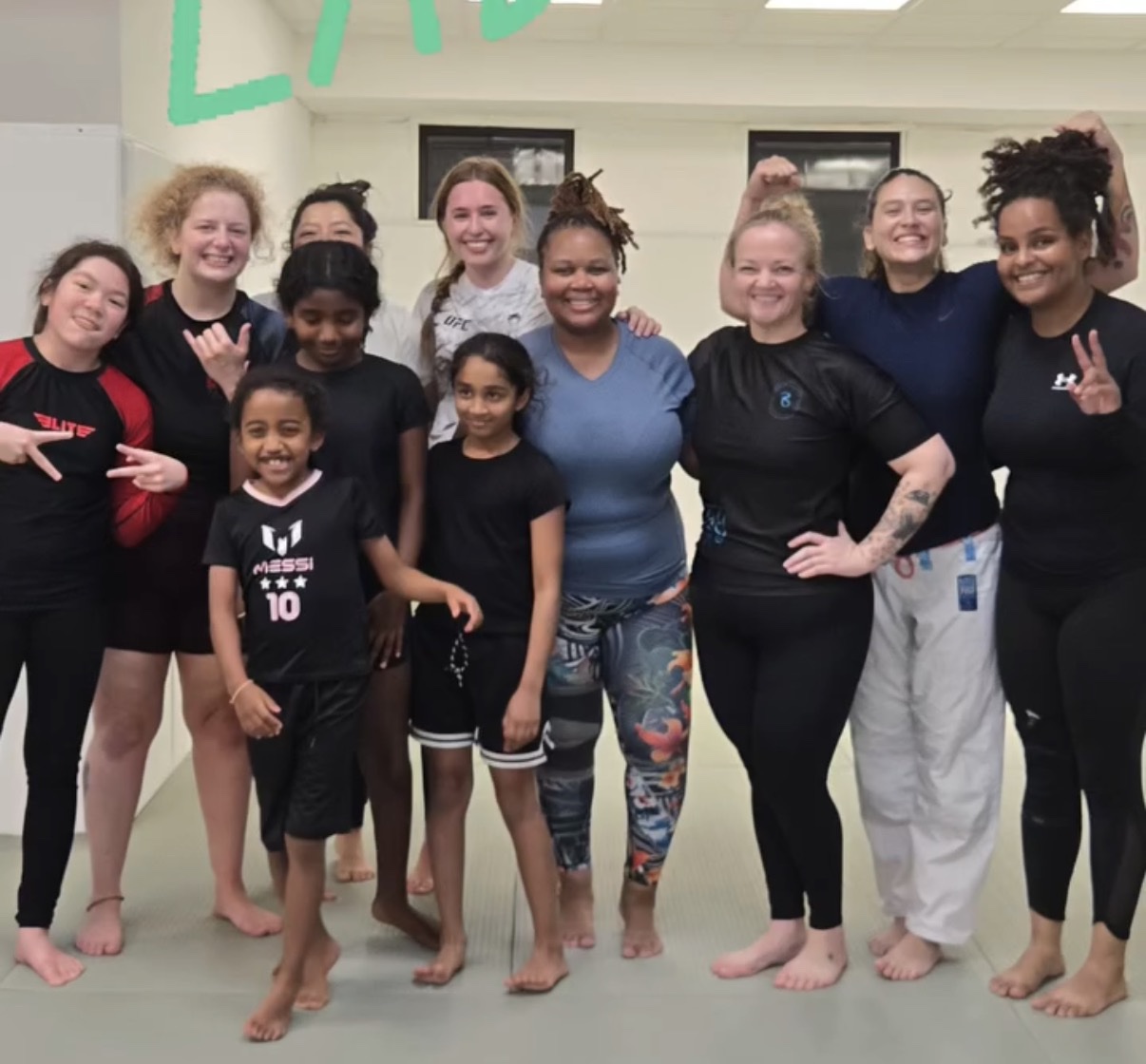
Girls in BJJ
More girls are choosing jiu-jitsu \u2014 and staying with it. Why the art fits, what a class actually looks like for your daughter, and how to let her judge it for herself.
Twenty years ago, a girls' jiu-jitsu class would have been a novelty. Today, walk into a kids class in Takoma Park and you will see girls tying their belts next to boys without anyone thinking twice about it — drilling the same escape, solving the same problem, earning the same stripe. Parents notice the change and ask us two honest questions: why is this art, of all arts, drawing more girls in — and is it actually right for my daughter? Here is the answer we give on the mat, without the sales pitch: what BJJ genuinely offers a girl, what it does not promise, and how to let her judge it herself.
An art built on leverage, not size
Start with how the art itself works. Brazilian jiu-jitsu is grappling: there is no punching, no kicking, and no striking at all. The core skill is positional — how to hold and control a partner, how to escape from underneath someone bigger, how to protect yourself on the ground and get back to your feet. The method underneath all of it is leverage: using angles, frames, and timing so that technique does the work strength cannot. That design matters for girls in a way it simply does not in most sports. A girl does not have to be the biggest or strongest child in the room for the technique to work — the technique was built, from the beginning, for the smaller person in the exchange. Parents looking for an activity where their daughter is not at a built-in physical disadvantage tend to notice that quickly.
What a class actually looks like for her
A kids class follows the same rhythm every time, and the predictability is part of the point. Children warm up and move together, the coach demonstrates one technique in small steps, and then children practice it with a partner — matched by the coach, by age and size — before short, supervised practice rounds, often starting from a set position. Our kids jiu-jitsu program groups children by age: the youngest train in Little Grapplers (ages 4–6), older kids train in their own group, and teenagers have a room of their own. Girls are not given a softened version of any of this. Your daughter learns the same positions, the same escapes, and the same standards as every child in her group — because a separate, easier track would teach her less, and she would know it.
Training alongside boys — and why pairing is the coach's job
The question parents ask most quietly is about the room itself: will she be grappling with boys? In the kids program, yes — girls train in their regular age group, alongside boys, and that is deliberate. The skill being built is dealing with a real partner in front of you, and in any real situation that partner is not chosen for comfort. What makes that workable and safe is everything around the pairing: the coach selects partners by age and size rather than leaving it to chance, every exchange is supervised, the pace is set by the drill, and every child — your daughter included — holds a stop signal that ends any exchange instantly. That signal, the tap, is taught on day one, before any real technique, and it is always respected. We lay out how all of that works in is BJJ safe for kids? — the honest version, including what can still happen.
Why girls stay: the reasons parents actually report
Ask parents why their daughters keep coming back and the answers are refreshingly unglamorous. The progress is visible and personal: an escape that did not work last month works today, and she can feel the difference herself — no scoreboard, no selection, no waiting for a coach to pick her for a team. The problem-solving suits girls who were bored by repetitive drills: every round is a physical puzzle against a partner who is also thinking, so no two rounds are the same. And the room itself matters — girls train next to other girls and, as they get older, can see exactly where the path leads. No responsible coach will promise you a particular change in your daughter's confidence or character; children are not products, and outcomes are not ours to guarantee. What class does provide, every single session, is a structured place to practice hard things — being uncomfortable, failing at a technique, trying again — with a coach watching and a partner who respects the tap.
A path that does not end at childhood
One reason more families choose BJJ for a daughter is that the road visibly continues. When a girl outgrows the kids groups, she moves into the teens program (ages 13–17), training with her own age group rather than being absorbed into an adult room too early. And beyond that, the academy runs a women's-only program — women's sessions every week, in both gi and no-gi — where adult women train complete jiu-jitsu together, from complete beginners to experienced students. For a parent, that changes the picture: this is not an activity with an expiry date at age twelve, but a skill she can carry into her teens and adult life, in rooms built for each stage. Competition exists for girls who want it, on the same terms as everyone else — and it is never required of anyone.
The honest way to decide is not this page — it is one real class, watched with your own eyes. At WDC BJJ in Takoma Park, the first class is free: a real group class with your daughter's own age group, no uniform, payment, or contract needed, and you watch from the side of the mat the entire time. If she spends the drive home showing you the escape she learned, you have your answer. Book a free class and let her be the judge.
Your first class is free.
A real group class with your own group. No experience needed, no payment, no contract for a trial — and enrollment includes a free uniform.
1. Send the free-trial request or call (202) 636-3453.
2. We confirm the right class for your age and schedule.
3. Arrive 15 minutes early in athletic clothes with water.
4. Train a real class — then decide with zero pressure.
Girls in BJJ, answered
It can be a strong fit for many girls, for a practical reason: Brazilian jiu-jitsu is built on leverage, timing, and technique rather than size and strength, and there is no striking at all. Girls train the same real skills as everyone else in their age group — positions, escapes, control, and how to fall safely — with partners matched by age and size and a coach watching every pair. No sport is right for every child, which is why the honest test is one real class, watched with your own eyes.
In the kids program, girls train in their regular age group alongside boys, and the coach — not the children — chooses partners, matching by age and size. That mixed room is deliberate: the skills are practiced against whoever is in front of her, at a controlled pace she can stop at any time with a tap. When she is older, the path continues: teenagers 13–17 train in a group of their own, and adult women have a women's-only program with sessions every week.
No. Most girls who start have no martial arts background at all, and nobody expects strength or flexibility on day one. The technique is designed to work through leverage instead of muscle, coaches demonstrate everything in small steps before children try it, and fitness is built gradually by the training itself. What a first class actually asks for is much simpler: athletic clothes, a water bottle, and a willingness to try one real group class.
No physical activity is completely risk-free, and any school that promises otherwise is not being straight with you. What a parent can judge is control: there is no punching or kicking, every drill stops instantly with a tap — a signal taught on day one that any child can use at any time, for any reason — partners are matched by age and size, and parents watch the whole class from the side of the mat. We answer the safety question in full in our guide to whether BJJ is safe for kids.
A well-run kids class is more predictable than it looks from the door: the same rhythm every time — warm-up, one technique shown in small steps, supervised practice with a partner her own size, then controlled mat time. New children are not thrown into live rounds on day one, and a child can tap, pause, or step out at any moment. Some quiet children take a few classes to settle in, and that pace is fine. Watch the first class from the side of the mat and let her reaction — not anyone's sales pitch — make the call.