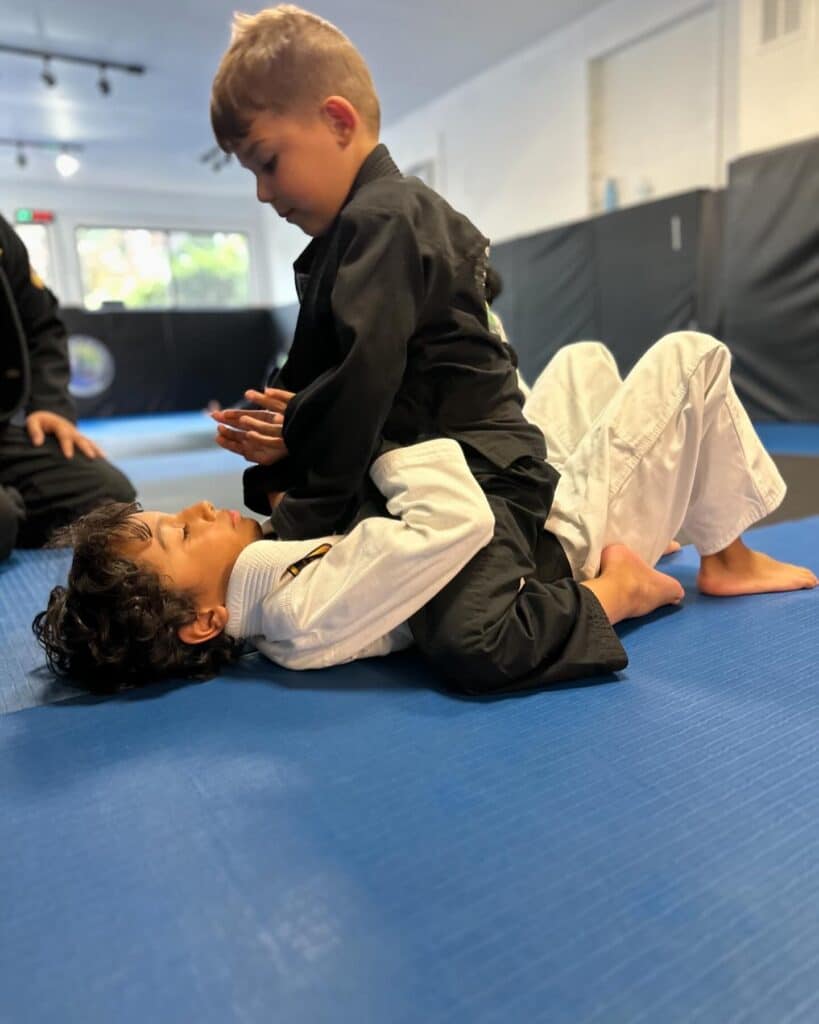
How Jiu-Jitsu Helps Kids Make Real Friends
Friendship cannot be assigned, but it can be set up. Same partners, same struggle, week after week — the mats create the conditions, and kids do the rest.
Ask parents what actually keeps them up at night and, once the grades and the screens are mentioned, it usually comes down to this: does my child have friends? A move to a new neighborhood. A new school where every group already seems formed. A quiet kid who eats lunch a little apart from everyone. Parents bring that worry to our academy in Takoma Park more often than any question about technique, and they are right to treat it seriously — belonging is not a bonus in childhood, it is the foundation everything else sits on. We cannot hand a child a friend. What a jiu-jitsu academy can do, better than almost any setting we know, is build the exact conditions friendship grows in — and then get out of the way.
Friendship needs repetition, and class is repetition
Adults forget how friendship actually starts: not with a great conversation, but with seeing the same person, in the same place, doing the same thing, over and over, until talking becomes easy. School should provide that, but school groups are enormous and constantly reshuffled. A jiu-jitsu class is small and stable. Your child trains at the same time, with the same age group, alongside the same faces, two or three times a week. The shy kid does not have to “break in” — there is no in to break. They just keep showing up, and familiarity does the slow work. Coaches learn every child’s name in the first class, and use it constantly; being known by name, out loud, in front of peers, is a small thing that is not small at all to a child who feels invisible elsewhere.
Partners, not opponents
The engine of friendship here is the partner system. Every drill in jiu-jitsu takes two people, and partners rotate through the class — which means your child works directly, physically, cooperatively with every kid in the room, including the ones they would never have chosen and never been chosen by. Working a technique together is a shortcut past small talk: you have a shared job, you help each other get it right, you laugh when it goes wrong. Taking care of your partner is a rule of the academy — their safety is in your hands — and children rise to that responsibility in a way that builds trust fast. Some of the strongest friendships we have watched start here began between two kids who had nothing in common except a mat and a drill.
Shared struggle bonds people — kids included
There is a reason teammates from any hard endeavor stay close for years: struggling at something together, and improving at it together, is bonding in its purest form. Jiu-jitsu is honestly difficult. Everyone in the room gets stuck under the same positions, fails at the same escapes, and has the same breakthroughs a few weeks apart. A child who is behind at school and behind socially walks into a room where everyone is a beginner at something, failure is public and normal, and improvement is celebrated out loud — stripes and belts are awarded in front of the whole class, and the room applauds, because the room knows exactly what it cost. Being cheered by name, by peers, for something you earned: a lonely kid does not forget that.
What parents usually notice, and when
Honestly, it is gradual. First a name gets mentioned at dinner — a partner from class. Then your child starts arriving early on purpose, or asking whether a particular kid will be there Saturday. Then come the birthday invitations and the requests to stay for open mat. We see it across ages: our Little Grapplers, ages 4 to 6, bond over games and giggling; the 7-to-12 groups form the intense, loyal friendships of middle childhood; and our teens, who have their own dedicated class, build the kind of crew that gets a fourteen-year-old through high school. If your child is shy, our post on jiu-jitsu for shy kids describes what the first weeks usually look like for quieter children.
Give it a room to happen in
WDC BJJ is family-owned, and the community is not a slogan — families here know each other, siblings train across age groups, and parents watch from the side together week after week. If friendship is the thing you are really shopping for, come and watch a class at 720 Erie Ave and judge the room for yourself. The first class is free: a real group class, no payment and no contract for a trial, and a free uniform if your child enrolls. Kids ages 4 to 12 train at 5:00 PM on weekdays in age groups, with a 9:00 AM kids no-gi class on Saturdays. Send the free trial request or call (202) 636-3453, and let the mats introduce your kid to their people.
Your first class is free.
A real group class with your own group. No experience needed, no payment, no contract for a trial — and enrollment includes a free uniform.
1. Send the free-trial request or call (202) 636-3453.
2. We confirm the right class for your age and schedule.
3. Arrive 15 minutes early in athletic clothes with water.
4. Train a real class — then decide with zero pressure.
Kids, friendship, and the mats, answered
The format works against edges: there is no group to break into, because the class is the group, and partner drills rotate your child through direct, structured contact with everyone. Nobody has to find an opening in a conversation — the drill is the opening. Quiet kids often do well here precisely because interaction has a job attached to it.
It is one of the most reliable ones we know. The class is stable week to week, kids train with the same group, and parents watch from the side together — most of our families’ local friendships, adult ones included, started on that bench. Takoma Park, Silver Spring, and DC families all train here.
Names and comfort usually come within the first few weeks; real friendships build over a season of showing up. The variable that matters most is consistency — the same class times, kept up. Friendship here is a byproduct of attendance, which is a kind thing to tell a parent: you do not have to engineer it, just keep the Tuesdays and Thursdays.
Kids ages 4 to 12 train in age groups at 5:00 PM, Monday through Friday — ages 4 to 6 are the Little Grapplers — and Saturday has a 9:00 AM kids no-gi class. Teens 13 to 17 have their own dedicated class. Within a class, partners are matched by size and experience.
Send the free-trial request or call (202) 636-3453, and we will confirm the right class for your child’s age. Arrive about 15 minutes early in athletic clothes with a water bottle — no uniform needed to try. Your child joins a real group class and you can watch the whole time. No payment, no contract for a trial, and the uniform is free if you enroll.