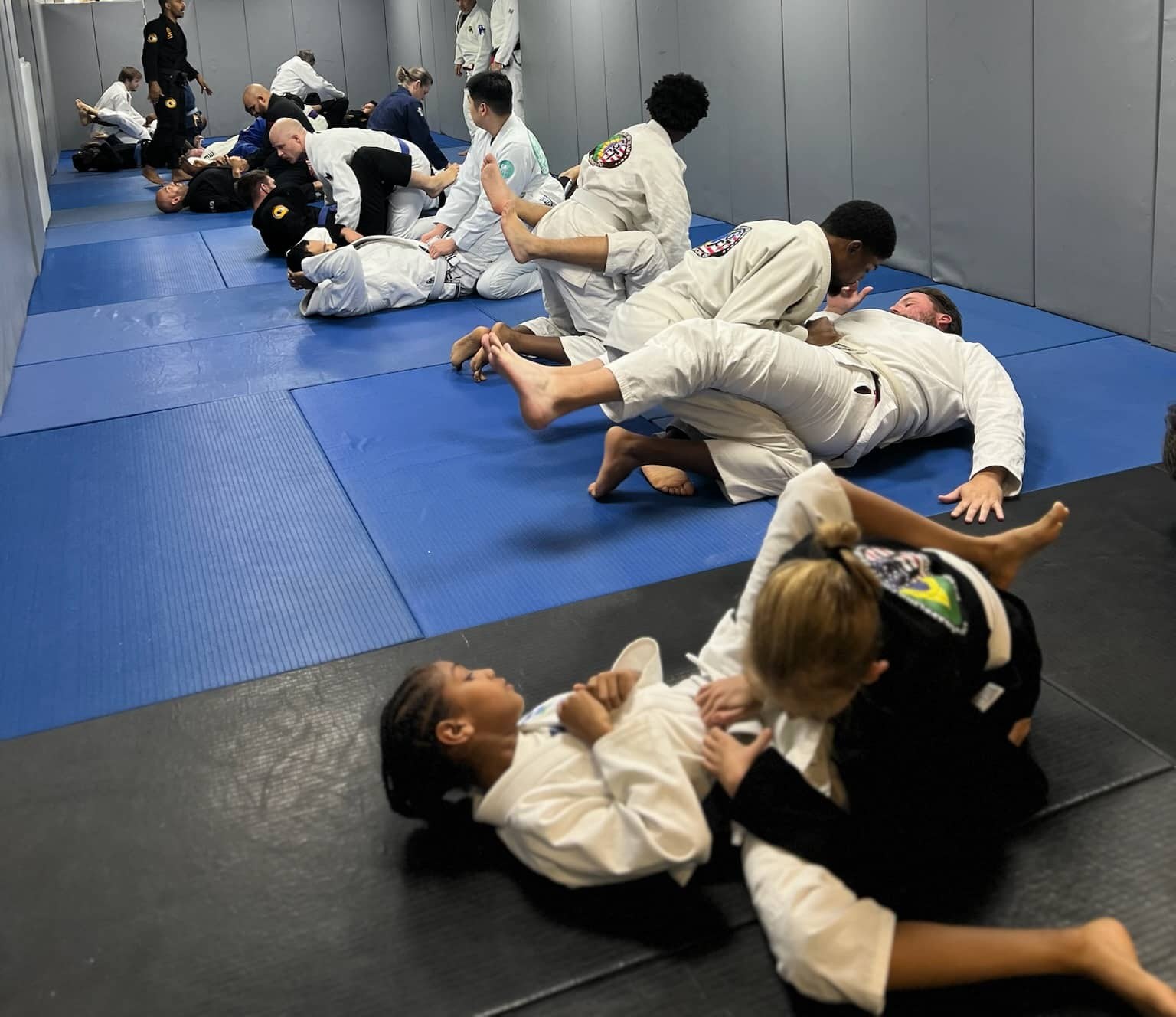
How to Choose a BJJ School
Nine questions to ask about coaches, safety, beginner classes, and contracts — so you can judge any school, including ours, in one real visit.
Choosing a Brazilian jiu-jitsu school looks simple — find one nearby, check the schedule, sign up. In practice, schools that look similar on a website can feel completely different on the mat. Who actually teaches your class, how beginners are paired, whether a child can stop an exchange at any moment, and what you are agreeing to when you sign — none of that shows up in a trophy photo. These nine questions are the ones we would ask for our own family. Ask them of any school you visit in the Takoma Park area, including ours, and judge the answers in the room.
1. Who actually teaches the class I would join?
Ask who leads the class, not just who founded the school. Coaches should be described by their role — who runs the kids program, who leads beginner adults, who supervises live training — and you should be able to see that person teach. Watch how they correct, whether they know students’ names, and whether they step in when a pairing is not working. A school is the people in the room on an ordinary Tuesday. See our instructors page, but the real test is watching a class.
2. Do beginners — and children — have their own groups?
A good school does not throw a first-day student in with experienced competitors, and it does not mix young children, older kids, teenagers, and adults in one group. At WDC BJJ, the youngest children train in Little Grapplers (ages 4–6), older kids train in their own group, teenagers 13–17 have a group of their own, and adults start in beginner classes of their own — see our kids jiu-jitsu program and beginner adult BJJ pages for how those groups are set up. Ask any school to name the exact group you or your child would join, and then watch that group train.
3. Is the free trial a real class?
A trial should show you the product, not a pitch for it. Here, a free trial is a real group class with your own group — no experience needed, no uniform, payment, or contract needed for the trial, and parents are welcome to stay and watch their child’s class. You warm up, learn, and practice the same way regular students do that day. If another school offers only a tour or a sales lesson, you still do not know what regular training feels like — and that feeling is the decision.
4. How is safety handled, in practice?
Do not settle for ‘we take safety seriously.’ Look for specifics you can verify in one visit. Is the tap — the signal that stops any exchange instantly — taught on day one and respected every time? Are partners matched by age and size for children and chosen thoughtfully for beginners? Does a coach supervise live practice and stop rounds cleanly? Are students taught to fall safely? BJJ has no punching or kicking, and training should feel controlled even when it is hard.
5. Does the schedule actually fit my life?
The best program is the one you can attend consistently. Check the real class times for your group, not just the longest list on the website, and think about the drive, parking, and the hour before and after class. Our current hours are on the class schedule — the academy in Takoma Park runs Monday 4–8 PM, Tuesday through Thursday mornings and evenings, Friday 4–7 PM, and Saturday 9 AM–12 PM, and is closed on Sunday. Ask any school which two classes a week a beginner in your group would realistically attend, and picture that week honestly.
6. What is included — and what else will I need to pay for?
Ask for the full picture before you sign: what classes are included, whether a uniform is required and what it costs, whether there is a registration cost, and what happens if you need to pause. At WDC BJJ, enrollment includes a free uniform — stated up front because surprise costs after signing are a common complaint in martial arts. Whatever a school charges, it should explain every part of it in writing. If pricing feels evasive in person, expect the same later.
7. How will I know I am progressing?
BJJ progress is slow and real, and a good school can describe how it is recognised without promising a belt by a date. Ask how stripes and belts work for children and for adults, who decides, and what regular attendance looks like over months, not weeks. Be cautious with any school that guarantees a belt, a result, or a change in a child on a timeline — progress depends on showing up and doing the work, and no coach can promise the outcome in advance.
8. What is the culture on the mat?
Watch how students treat each other. Do experienced students help beginners or ignore them? Is hard training matched with control, and is anyone pressured to continue after tapping? For children, watch whether the class has structure — listening, lining up, taking turns, following through — taught as part of training. Culture is not a slogan on a wall. It is whether you would feel comfortable leaving your child in that room, or starting as the least experienced adult in it.
9. What am I signing, exactly?
Finally, read the agreement the way you would read any other: term, renewal, cancellation, and what happens if you move or get injured. Ask for it before you are handed a pen, take it home if you need to, and never let a first-visit discount rush that reading. Enrollment at a good school should be a decision the school is happy for you to think about — at WDC BJJ it stays hand-picked and personal: trial first, meet, then decide together whether it is a fit. A school that trusts its classes does not need to close you on day one.
Use these nine questions as a checklist, visit more than one school if you can, and trust what you saw over what you were told. If you want to put us through the same test, book a free class at our academy at 720 Erie Ave in Takoma Park, watch from the side of the mat, and ask us every question on this list. The answers are in the room.
Your first class is free.
A real group class with your own group. No experience needed, no payment, no contract for a trial — and enrollment includes a free uniform.
1. Send the free-trial request or call (202) 636-3453.
2. We confirm the right class for your age and schedule.
3. Arrive 15 minutes early in athletic clothes with water.
4. Train a real class — then decide with zero pressure.
Choosing a BJJ school, answered
Start with who teaches and how beginners are handled. Ask who leads the class you would actually join, what their role is at the school, and whether beginners and children train in their own groups. Then watch a real class: partners should be matched thoughtfully, a coach should be watching every pair, and anyone should be able to tap and stop an exchange instantly.
It should be a real class. At WDC BJJ in Takoma Park, a free trial is a real group class with your own age or level group — no uniform, payment, or contract needed for the trial, and parents can watch from the side of the mat. If a school will only let you watch a demo or sit through a sales talk, you have not actually seen what you would be paying to attend.
Look for clear signals you can see in one visit: the tap is taught on day one and respected every time, partners are matched by age and size for children and by experience for beginners, a coach chooses pairings and supervises live practice, and warm-ups, falling safely, and escapes come before harder training. A clean mat, a clear start and stop to every round, and calm corrections are also good signs.
You should never feel you have to. Ask plainly, before you sign anything, what the term is, how cancellation works, what is included, and whether there are other required costs such as a uniform or registration. A school that believes in its classes can explain those terms in writing and let you take a trial class and think it over at home.
No — good schools separate them. At WDC BJJ, the youngest children train in Little Grapplers (ages 4–6), older kids train in their own group, teenagers 13–17 have a group of their own, and adults have beginner and other classes of their own. Different ages need different pacing, partners, and teaching, and a school should be able to show you the exact group you or your child would join.