How Can You Help Your Child Stick With BJJ (Without Pushing)?
The first classes run on excitement. Then one day your child says they do not feel like going — and every parent asks the same question: how much do I push? Here is what actually helps kids stay with jiu-jitsu for the long term, from the mat side of the room.
Almost every parent at our academy knows this pattern. The first weeks of Brazilian jiu-jitsu are easy: the uniform is new, the games are fun, and your child runs to the door on class days. Then the novelty wears off. A technique is hard to learn, a training partner is better than they are, and the voice from the back seat says the sentence every parent dreads: “I don’t want to go today.” Parents at WDC BJJ in Takoma Park ask us about this moment more than almost anything else. The honest answer is that sticking with BJJ is rarely about motivation. It is about routine, about what gets noticed at home, and about a parent’s job being different from the coach’s job.
Let the routine make the decision, not the mood
The most useful thing a family can do is decide once, instead of deciding every class day. Pick the days that fit your week — our kids jiu-jitsu classes for ages 4–12 run Monday through Thursday at 5:00 PM, with a Saturday 9:00 AM class for younger and smaller kids — and treat those days like school days: they are simply what happens on a Tuesday. A daily negotiation (“do you feel like going today?”) hands a young child a decision they cannot make well at 4:30 PM on an empty stomach. Keep the practical side steady too: a snack before class, the uniform ready, arrival a few minutes early so your child walks onto the mat settled instead of rushed.
Notice the small progress — out loud, and specifically
Children repeat what the adults around them notice. Vague praise fades fast, but a specific observation lands: “You kept trying that escape even when it didn’t work,” or “You listened the first time the coach explained it.” Those comments tell a child which behaviors are worth repeating, and they are all things a child controls — effort and listening — rather than things they do not, like winning every round. Progress is built out of those small pieces: one technique taught in small steps each class, practiced with a partner their own age and size, stacking week over week. That is also why we mark progress the way we describe in how kids’ belts and stripes work: stripes and belts are the coach’s decision, based on attendance, attitude, and skill over time. A stripe is proof to a child that showing up adds up. What undermines it is turning the next stripe into a bargaining chip at home, or comparing your child’s pace to a sibling’s or a classmate’s — kids rarely hear those comparisons as encouragement.
Let the coach coach — your job is the ride home
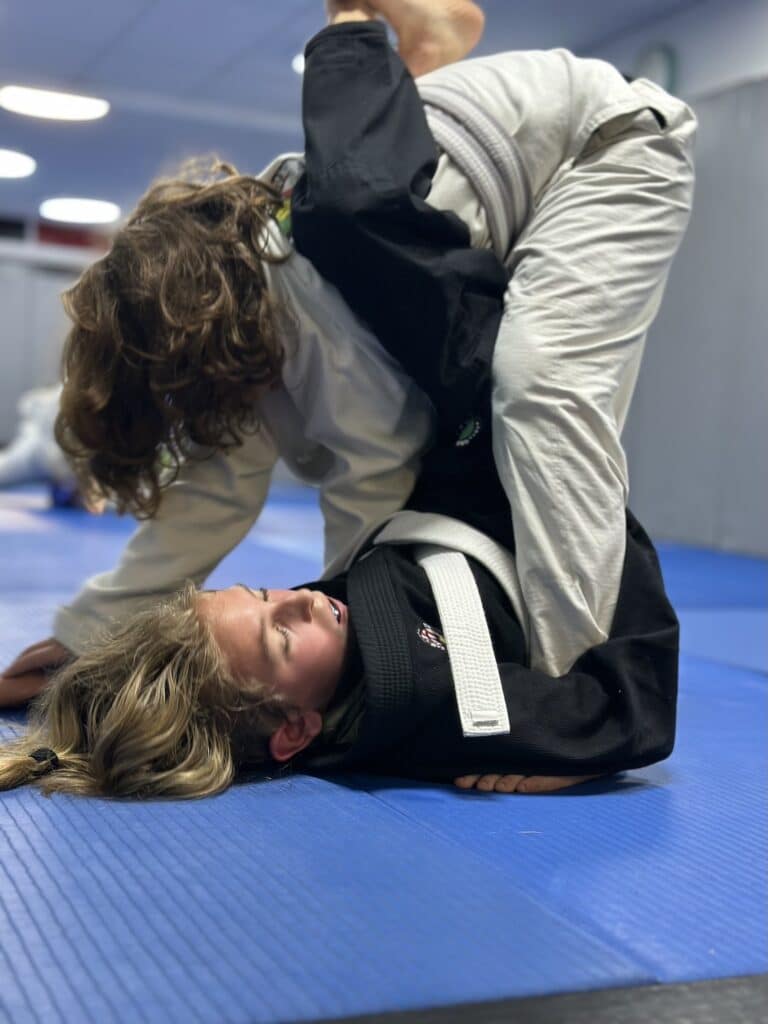
At WDC BJJ, parents watch class from the side of the mat, and that seat comes with a specific role. Resist coaching from the sideline: a child who hears instructions from two directions stops listening to both. The harder test is the difficult moment — your child is underneath a partner, or a technique fails for the fifth time. Those moments are not accidents; they are a large part of what the class is for, and the coach is watching them happen. Stepping in too quickly sends a message no parent intends: that you do not think your child can handle this. If something genuinely concerns you, raise it with the coach after class, away from your child, so it can actually be addressed. And keep the ride home light: a long technical debrief turns an activity into homework. Ask what was fun, ask who they trained with, and stop there.
Expect the plateau, and say so before it arrives
Jiu-jitsu progress does not move in a straight line. There will be weeks when your child seems to stand still, when the same escape fails the same way, when everyone else’s improvement feels obvious and theirs feels invisible. Part of that is arithmetic: their partners are improving at the same time, so the gap stays similar even as everyone gets better. Families who know this dip is coming handle it very differently from families who read it as a verdict on the program, or on their child. Name it plainly: plateaus are a normal stretch of learning anything real, and they end the same way they started, by continuing to show up. No honest coach can promise a date when it will turn — but the children who come through a plateau are the ones whose routine carried them across it.
When your child says “I want to quit”
Sooner or later, most parents hear it about something. The first rule is timing: do not decide in the parking lot after a hard class, when everyone is tired. Listen first, and find out what the sentence actually means. Often it is one specific thing — a drill that felt embarrassing, a partner who was hard to train with, a day when they were simply worn out before class began. Specific things can usually be fixed: children are grouped by age and size, partners rotate, and the coach cannot address a problem nobody mentions. Bring it to the coach before you decide anything. The second rule is honesty about the other possibility: if a child has been unhappy for weeks and has said so calmly more than once, that is information too, and forcing months of misery rarely produces a child who loves jiu-jitsu. Many families find a middle path works best: agree together to finish a short, clear stretch — a few more weeks of regular classes — and then revisit the conversation, so nobody feels pushed in either direction.
Start with one class, and watch how it runs
None of this requires a child to be a natural. It starts the same way for every family at our academy: with one real class. A first class at WDC BJJ is free — a real group class with their own age group, not a private sales session — and parents watch from the side of the mat, so you can see the rhythm, the coaching, and how children are grouped before you decide anything. Our youngest students start in Little Grapplers, ages 4–6, where learning happens through movement and play. WDC Brazilian Jiu-Jitsu is at 720 Erie Ave in Takoma Park. Book a free class or call (202) 636-3453 — and if your child is already training and hits the dip, remember: it is normal, it is usually fixable, and it is rarely a reason to stop.
Your first class is free.
A real group class with your own group. No experience needed, no payment, no contract for a trial — and enrollment includes a free uniform.
1. Send the free-trial request or call (202) 636-3453.
2. We confirm the right class for your age and schedule.
3. Arrive 15 minutes early in athletic clothes with water.
4. Train a real class — then decide with zero pressure.
Helping your child stick with BJJ, answered
It is one of the most common patterns in any kids activity, and it usually is not about jiu-jitsu itself. The first weeks run on novelty; after that, the real learning begins — a technique takes effort, a partner is challenging, or your child is simply tired that day. A dip after a hard class is different from steady unhappiness over weeks. Ask what part of class felt hard, listen before you answer, and mention it to the coach, who sees your child on the mat and can often fix a small, specific problem — a partner match, a confusing step, a rough day — before it becomes a reason to stop.
Two to three times a week is a great rhythm once a child is enrolled at WDC BJJ — consistency matters more than intensity. Kids classes for ages 4–12 run Monday through Thursday at 5:00–5:45 PM, and younger and smaller kids can also train Saturday at 9:00 AM. Pick the same days each week and protect them: a rhythm a child can predict is far easier to keep than a schedule that changes every week, and progress — the thing that keeps kids interested — only shows up with regular attendance.
Do not decide in the parking lot after a hard class — for you or for them. Listen first and find out what actually happened: there is a real difference between a bad day, one specific problem the coach can address, and a child who has been unhappy for weeks. If it is not a safety concern, most families do well agreeing to come back for a few more classes and then talking again, calmly. Skipping the first hard patch teaches one lesson; being forced through months of misery teaches another. You know your child — the goal is an activity they return to willingly for a long time.
They give a child visible proof that showing up is adding up. As we explain in our guide to kids belts and stripes, stripes and belts at WDC BJJ are the coach's decision, based on attendance, attitude, and skill over time — they are earned, not given out on a schedule. That is exactly why they work as motivation: a stripe tells a child their effort was seen. The trap for parents is turning the next stripe into the price of every class. Notice effort and specific progress out loud, and let the coach handle promotions.
Send the free-trial request or call (202) 636-3453, and we will confirm the right class for your child's age and your schedule. Arrive 15 minutes early in comfortable athletic clothes — no pockets or zippers — with a water bottle, and check in at the door. Your child trains a real group class with their own age group; there is no payment and no contract for a trial. Parents watch from the side of the mat, so you can see exactly how class runs. Afterwards we walk you through how the program works and answer every question, with zero pressure. If you decide to enroll, the uniform is included free.