Is Jiu-Jitsu Safe for Women? An Honest Answer
Not “completely safe” — nothing physical is. Honest risks, honestly managed, inside a culture where you control every round. Here is the full picture, from the academy that runs the class.
It is the first question most women ask us, and it deserves better than a sales pitch. Is jiu-jitsu safe for women? The honest answer has two halves. Jiu-jitsu is a contact martial art, and contact means the ordinary risks of contact: you will be sore in your first weeks, you will collect bruises, a finger will get jammed at some point, and rolling with another human being is never a zero-risk activity. Anyone who tells you otherwise is selling something. The other half is that jiu-jitsu’s safety culture is unusually strong — stronger than most sports — because the entire art is built around one absolute mechanism of consent and control: the tap. This page lays out both halves, and how we run women’s training at WDC BJJ in Takoma Park, so you can decide with open eyes.
The tap: the rule that runs the whole room
Every technique in jiu-jitsu ends the same way — with a tap. When you tap your partner, the mat, or simply say the word, everything stops. Instantly. Not when the technique is finished, not after a discussion — now. That rule is sacred in every reputable academy, and it means something specific for a woman deciding whether to train: you are never trapped in a situation you did not agree to continue. You choose your effort level in every round, you can stop any drill at any moment for any reason, and nobody — nobody — overrides that. Beginners start with cooperative drilling, where a partner feeds you the position slowly so you can learn the movement. Live rounds are always an offer, never an obligation, and many women spend their first weeks purely drilling. That is not a lesser version of training. That is training.
Women’s-only classes, led by a woman
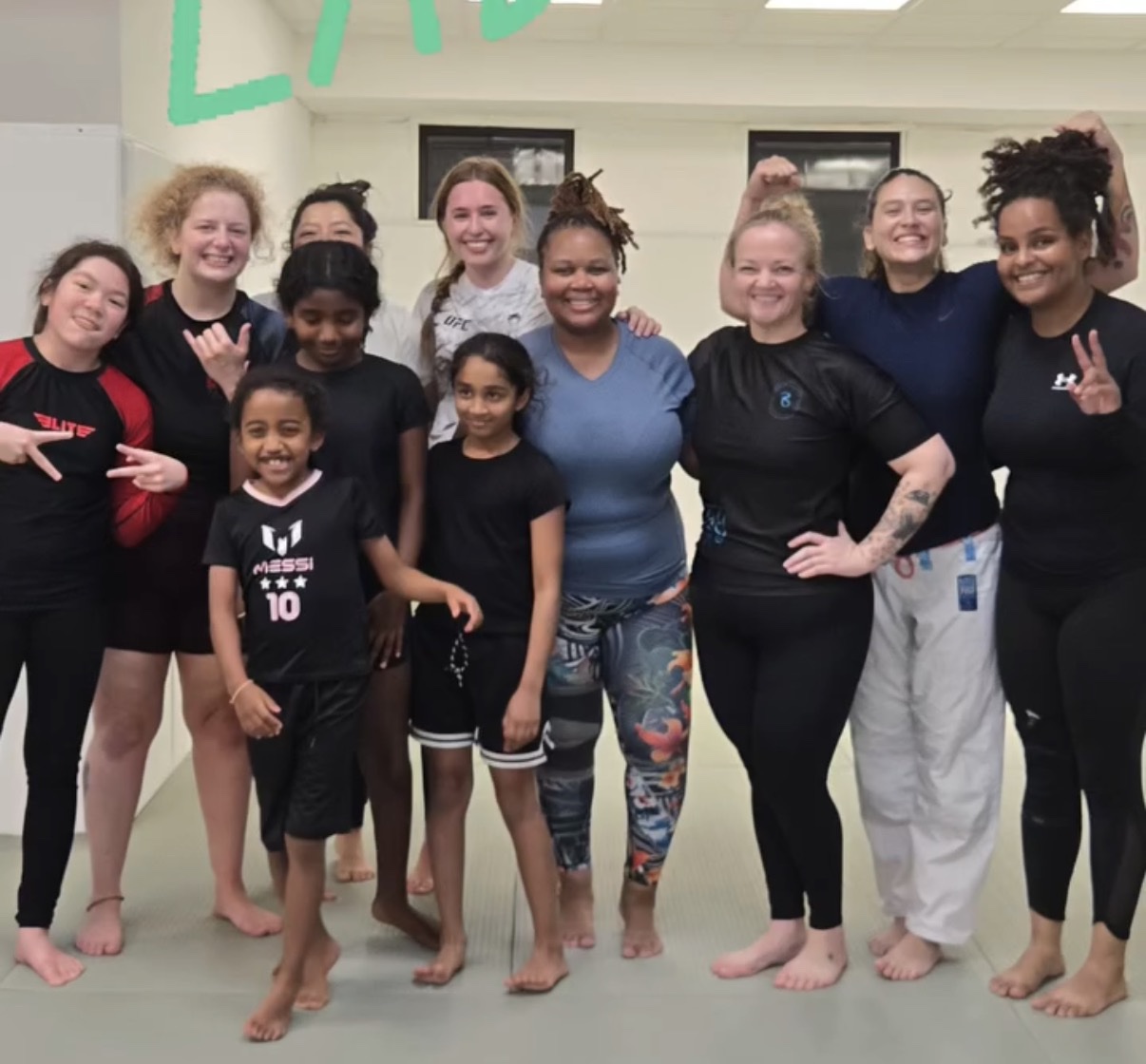
Our women’s program is led by Professor Charlene, and it runs three times a week: Monday 6:00 PM no-gi, Wednesday 6:00 PM gi, and Saturday 11:00 AM gi. The women’s-only room changes the math for a lot of beginners. Your partners are women. The pace is set by the women in it. Questions that might feel awkward anywhere else — about size differences, about training while pregnant someday, about what to do when a technique involves someone’s full weight on you — are just class discussion here. Many students start in the women’s-only classes and later add the mixed adult classes when they want more partners and more rounds; some train women’s-only for years. Both are normal, and the choice stays yours the whole way. You can read what the class is actually like in our post on the women’s-only jiu-jitsu class.
The risks, itemized — and what we do about each
Let’s be specific, because vague reassurance helps nobody. Soreness: real, universal, worst in weeks one and two, then your body adapts — this is true of any new physical training. Bruises: common, cosmetic, mostly on arms and legs from grips. Jammed fingers and toes: the most frequent minor injury in the sport, managed by trimming nails, taping fingers if you like, and learning to grip without panic. Joint injuries: rare when the tap is respected, which is why we drill the tap as a reflex from day one and why partners are matched by size and experience for beginners. And the cultural risks women reasonably ask about — being paired carelessly, being treated as fragile or as a novelty — are managed by the simplest structure there is: this is a family-owned academy, the women’s program has a woman professor, and coaches are on the mats for every minute of every class.
Choosing your partners and your pace
A word about control, because it is the thing women most want to hear said out loud: you pick. You pick which classes to attend. You pick whether today is a drilling day or a live-round day. You can decline any partner or any round, at any time, without explaining yourself — “I’m sitting this one out” is a complete sentence here. As you gain experience, most women find their appetite for intensity grows on its own schedule; some become fierce competitors, and some train twice a week for fitness and community for a decade. Both are success stories. The academy’s job is to keep every version of that journey safe and welcoming. Our women’s jiu-jitsu page has the program details and the current schedule.
Come watch first, then decide
You do not have to commit to anything to evaluate us — in fact, we would rather you didn’t. Come sit at the side of the mats during a women’s class at 720 Erie Ave and watch how it actually runs: the coaching, the partners, the stopping, the laughing. If it looks like your kind of room, your first class is free — a real class, no payment and no contract for a trial, and a free uniform if you enroll. Arrive 15 minutes early in athletic clothes with a water bottle. Send the free trial request or call (202) 636-3453 and ask for a women’s class. Safe is not a promise anyone can make about a contact sport. Safer — structured, supervised, and always under your control — is a promise we can describe, demonstrate, and keep.
Your first class is free.
A real group class with your own group. No experience needed, no payment, no contract for a trial — and enrollment includes a free uniform.
1. Send the free-trial request or call (202) 636-3453.
2. We confirm the right class for your age and schedule.
3. Arrive 15 minutes early in athletic clothes with water.
4. Train a real class — then decide with zero pressure.
Women and jiu-jitsu safety, answered
Then you are starting exactly where the art expects you to start. Jiu-jitsu is leverage — it was designed so a smaller, weaker person can control a bigger, stronger one — and strength is something training builds, not something it requires. Beginners drill cooperatively at their own pace, and fitness arrives as a side effect.
No. Our women’s-only classes run three times a week — Monday 6:00 PM no-gi, Wednesday 6:00 PM gi, Saturday 11:00 AM gi — led by Professor Charlene. Many women also choose the mixed adult classes later for more training partners, but that is an option you can take or leave forever.
You tap, or say “stop,” and it stops — immediately, completely, no questions and no attitude. That rule protects everyone in the room and it is enforced absolutely. You can also decline any round or any partner at any time. Your training, your terms.
Soreness in the first weeks, bruises from grips, and occasionally a jammed finger — the ordinary tax of a contact sport. Serious injuries are rare in a room where tapping is respected and beginners are matched by size and experience. We would rather list the small stuff plainly than pretend the list is empty.
Send the free-trial request or call (202) 636-3453 and ask for a women’s class. Arrive about 15 minutes early in athletic clothes with a water bottle — no uniform needed to try. You join a real class at your pace, with no payment and no contract for a trial. If you enroll, the uniform is included free.