Karate vs Jiu-Jitsu for Kids: An Honest Parent’s Guide
Most parents start by searching "karate." Here is what each art actually teaches your child — from a jiu-jitsu academy that will tell you plainly when karate is the better fit.
If you typed "karate classes near me" into Google this week, you are in good company — karate is the word most of us grew up with for kids' martial arts, and for many Takoma Park, Silver Spring, and Washington DC parents it is simply the search that starts the journey. Both karate and Brazilian jiu-jitsu are real martial arts with real benefits for kids. They are also genuinely different — in what children practice, how they practice it, and what it prepares them for. We teach jiu-jitsu, and only jiu-jitsu, so read this as an honest comparison from one side of the fence: what karate does well, what jiu-jitsu does well, and how to choose.
What karate classes typically teach kids
Karate is a striking art from Okinawa and Japan. Kids learn punches, kicks, and blocks; they practice kata — choreographed sequences of movements performed solo and refined over months — and, as they advance, controlled sparring with protective gear. Around the technique sits a strong culture of etiquette: bowing, listening the first time, lining up, earning belt ranks step by step. The genuine benefits are easy to see: coordination, balance, focus, memory, and respect for ritual and instructors. For a child who loves movement patterns and the satisfaction of performing a form exactly right, karate gives them a lot.
What kids jiu-jitsu teaches
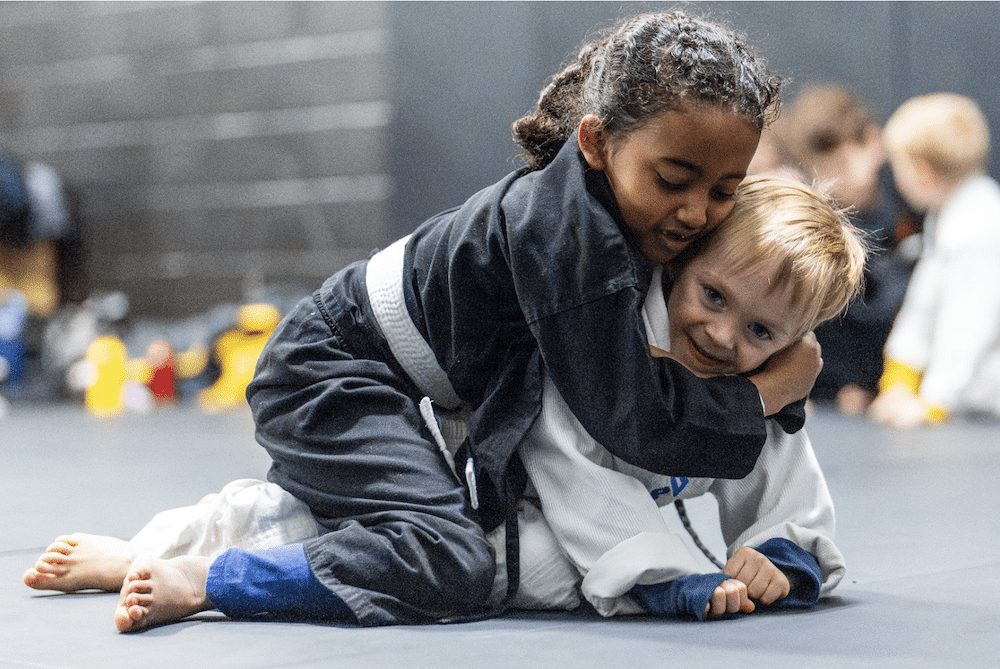
Brazilian jiu-jitsu is a grappling art. There is no striking at all — no punches or kicks to learn or to absorb. Kids learn how to close distance safely, take a partner to the ground in a controlled way, hold a position, escape from underneath, and — for older kids, introduced carefully and under close supervision — submissions. The defining feature is live practice: every class, children test what they learned against partners who are genuinely resisting, at an intensity coaches scale to the child. It looks like wrestling around on mats, because in a sense it is — structured, supervised, and purposeful.
The differences parents actually feel
Practice format. Karate spends much of class on forms and drills — movements rehearsed in the air or on pads, with sparring usually added later and kept controlled. Jiu-jitsu spends much of class in live rounds, so kids feel their technique working (or not) every single session. Contact. Karate contact is striking distance — hands and feet, pads and gear. Jiu-jitsu contact is body contact — clinches, holds, and the ground. Self-defense shape. Because jiu-jitsu is built around grabs, holds, and being underneath someone, it trains the close-range situations kids most often describe when someone puts hands on them: being grabbed, pushed, held, or knocked down. And temperament: some kids light up for the precision of forms; others need the problem-solving and full-body effort of grappling. Neither is better in the abstract — the fit is the thing.
What about judo, taekwondo, aikido, or Krav Maga?
Parents ask about these too, so briefly and fairly: Taekwondo is a Korean striking art famous for its kicking — dynamic, athletic, and an Olympic sport; like karate, it centers on strikes and forms. Judo is jiu-jitsu's closest relative — in fact, Brazilian jiu-jitsu grew out of judo a century ago. Judo emphasizes throws and pins; it's a wonderful grappling art, and the biggest difference is that jiu-jitsu spends far more time on ground control and escapes. Aikido is a Japanese art of blending with an attacker's motion into joint locks and throws, traditionally practiced cooperatively rather than with live resistance. Krav Maga is a self-defense system developed for the Israeli military, mixing striking with defenses against common attacks; it is designed for adults, and children's versions are uncommon. We teach none of these — each has its own schools and its own strengths — but knowing the map helps you read any academy's website honestly, including ours.
Why many Takoma Park parents who searched "karate" choose jiu-jitsu
Most parents who land here weren't really shopping for an art. They were shopping for an outcome: confidence, discipline, focus, a way to burn serious energy, and a child who could handle themselves if someone laid hands on them. When they watch a kids' class, a few things tend to land. The self-defense is practiced, not theoretical — kids escape real holds from real partners every week. There is no striking, which many parents of younger or gentler kids prefer. Progress is visible fast, because live rounds give children honest feedback. And the confidence that results isn't performed for a grading — it's the quiet kind that comes from having solved a hard physical problem a hundred times. That is the same training behind our kids jiu-jitsu program and our self-defense approach for the whole family.
When karate is the right choice
Honestly? If your child dreams of high kicks and striking, loves choreographed movement, or has a friend thriving at a good karate school — follow that. A child who loves their art trains for years; a child dragged to the "right" art quits by winter. We would rather you choose jiu-jitsu with open eyes than choose it because a website talked you out of karate. We don't teach karate, and we won't pretend jiu-jitsu is a substitute for it. It's a different, complete answer to the same parent question.
Seeing it beats reading about it
The fastest way to decide is to watch your child in a real class. Kids' free trials run at weekday 5:00 PM classes and Saturday 9:00 AM at our Takoma Park academy — book on the free trial page. If you're still comparing formats, our guide to gi vs no-gi for kids explains the two uniforms of jiu-jitsu itself, our martial arts in Takoma Park page shows every program in one place, and parents of daughters can read about our women's self-defense classes too.
Your first class is free.
A real class with Professor Deivid’s coaching team and our regular students. No experience needed, no payment, no contract for a trial — and enrollment includes a free uniform.
1. Send the free-trial request or call (202) 636-3453.
2. We confirm the right class for your age and schedule.
3. Arrive 15 minutes early in athletic clothes with water.
4. Train a real class — then decide with zero pressure.