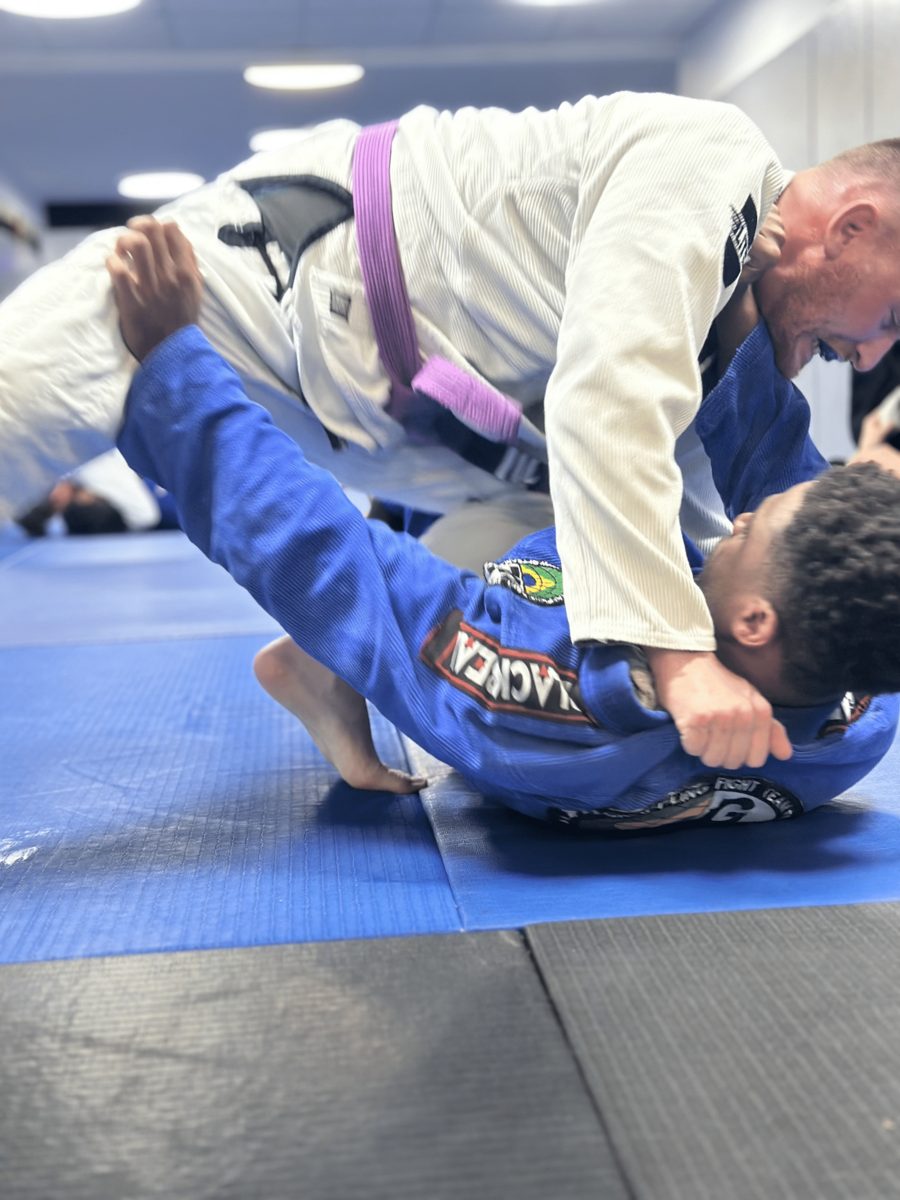
No-Gi BJJ, Explained: How It Differs and Who It’s For
Same art, no uniform — here is what actually changes when the grips come off the cloth, why no-gi rounds feel faster, and how to know whether this is the side of jiu-jitsu you will love.
Ask a room of jiu-jitsu students to explain no-gi and you will hear the short version first: it is Brazilian jiu-jitsu without the uniform. That is true, and it is also where most explanations stop — which leaves the interesting questions unanswered. If there is no uniform, what do you hold onto? Why does everyone say it feels faster? Is it a different sport, a harder sport, or the same sport in different clothes? And the question underneath all the others: is it for you? Here is the full explanation, the way we teach it at WDC BJJ in Takoma Park. Our Adults No-Gi page has the program details; this post explains what the program actually feels like and why it exists.
What “no-gi” actually means
In a gi class, you wear the traditional kimono — jacket, pants, and belt — and the uniform is part of the technique. You grip your partner’s collar, sleeve, and lapels; they grip yours. In no-gi, you train in athletic clothes instead: a rash guard or fitted shirt, and shorts or leggings without pockets or zippers. With no cloth to hold, control has to come from the body itself. Grips move to the wrists and arms. Control comes from underhooks — your arm threaded under a partner’s arm to steer their posture — from head position, from body locks, and from constant small adjustments of angle and weight. Nothing about the goal changes: you are still working for position, still escaping bad spots, still looking for submissions. What changes is the handle set. Gi jiu-jitsu hands you a jacket full of handles. No-gi makes you build the handles yourself, every exchange, and rebuild them the moment your partner moves.
How it differs from gi training
The first difference everyone notices is pace. Cloth creates friction, and friction creates pauses: a strong collar grip can freeze a round while both players think. Remove the cloth and rounds flow faster, with more scrambles — those quick, messy transitions where a position is won or lost in a second. The second difference is which techniques exist. A whole family of gi techniques depends on the uniform: collar chokes need a collar, lapel guards need a lapel. Those disappear in no-gi, and in their place the wrestling side of grappling grows: entries built on underhooks and body position rather than sleeve grips, and guards played with wrist control and movement instead of a fistful of jacket. The third difference is honest and physical: no-gi is slippery. Sweat plus athletic fabric means grips that would hold in a gi slide off, so no-gi rewards timing and re-gripping over holding on. Our post on gi vs no-gi for beginners walks through which style to start with; the short version is that the difference is real but smaller than the similarity.
What stays exactly the same
Everything structural. The positions are the same positions — guard, mount, side control, the back — and they are won and lost by the same principles of leverage, base, and posture. The escapes you learn in one format are the escapes you use in the other. The submissions overlap almost entirely. The tap rule is identical and absolute: a tap stops everything, instantly, in every class we run. And your rank is your rank in both rooms — the belt system does not split by wardrobe, so the student working toward blue belt is building one game, tested in both styles. That is why coaches here treat gi and no-gi as one program with two dialects, not two programs. Learn the language in either dialect and you are most of the way to understanding the other.
Who no-gi is for
Start with the obvious group: anyone whose interest in grappling began with MMA. No-gi is the grappling style used in mixed martial arts, so if that is the jiu-jitsu you have been watching, this is the room where it lives. It also suits people who think in terms of everyday clothing — nobody wears a kimono outside the academy, and no-gi control, built on underhooks and head position, is the side of grappling that translates most directly to ordinary clothes. Wrestlers crossing over tend to feel at home quickly, because so much of the control game is familiar. But the honest answer is wider: no-gi is for anyone who likes movement. Students who find the gi game slow often light up in no-gi, and students who train both usually find each style fixes the other’s habits — gi control sharpens no-gi patience, and no-gi movement speeds up the gi game. It is not a format you graduate to, and it is not a lesser format for people who dislike uniforms. It is half of the art. Kids get their own version too: our Saturday 9:00 AM kids class is no-gi, played at a kids’ pace with kids’ coaching.
How no-gi fits the week at WDC BJJ
No-gi is built into the adult week here, not treated as an afterthought. Thursday at 7:00 PM runs as No-Gi Drills inside the advanced schedule — focused repetitions of no-gi technique at a working pace. Saturday at 10:00 AM is No-Gi Open Mat, the week’s lab: your rounds, your pace, with coaches on the floor. The women’s-only program trains no-gi on Monday at 6:00 PM. Beginners do not start in the drills or the open mat; beginners start in the 6:00 PM beginner sessions, Monday through Thursday, where coaches teach the fundamentals for both styles side by side and point you to the no-gi sessions when you are ready. If you want a feel for the hour itself before you commit to a date, our walkthrough of your first no-gi class goes step by step, from the door to the last round.
The easiest way to understand it is to train it
No-gi is one of those things that explanations only half cover — the speed, the scrambles, and the problem-solving make sense in your hands long before they make sense on paper. Your first class at WDC BJJ is free: a real group class at 720 Erie Ave in Takoma Park, in athletic clothes with no pockets or zippers and a water bottle, nothing else needed. Book a free class or call (202) 636-3453, arrive 15 minutes early, and try the format for yourself. Then try a gi class the following week. Most students stop asking which one is better somewhere in that second week — and start asking how soon they can do both again.
Your first class is free.
A real group class with your own group. No experience needed, no payment, no contract for a trial — and enrollment includes a free uniform.
1. Send the free-trial request or call (202) 636-3453.
2. We confirm the right class for your age and schedule.
3. Arrive 15 minutes early in athletic clothes with water.
4. Train a real class — then decide with zero pressure.
No-gi BJJ, answered
No-gi is Brazilian jiu-jitsu trained in athletic clothes — a rash guard or fitted shirt and shorts or leggings without pockets or zippers — instead of the traditional uniform. With no collars or sleeves to grip, control comes from underhooks, wrist control, head position, and movement. The positions, escapes, and submissions underneath are the same art as gi training; only the handles change.
Comfortable athletic clothes with no pockets or zippers, and a water bottle — that is the full list for your first class. There is no uniform to buy to try no-gi, and your first class at WDC BJJ is free. If you later decide to train in the gi as well, enrollment includes a free uniform.
Not harder — different. No-gi rounds tend to move faster, with more scrambles, because there is no cloth to hold and slow things down. Gi rounds tend to feel more deliberate. Beginners at WDC BJJ start in the 6:00 PM beginner sessions, Monday through Thursday, where the fundamentals are taught for both styles, so you do not have to pick a side before you start.
No-gi is built into the week at our Takoma Park academy. Thursday at 7:00 PM runs as No-Gi Drills in the advanced schedule, Saturday at 10:00 AM is No-Gi Open Mat, and the women’s-only program trains no-gi on Monday at 6:00 PM. Kids train no-gi on Saturday at 9:00 AM. Beginners start in the 6:00 PM sessions, and coaches point you to the drills and open mat when you are ready.
Send the free-trial request or call (202) 636-3453, and we will confirm the right class for your age and schedule. Arrive about 15 minutes early in athletic clothes with a water bottle and check in at the door. You train a real group class — no payment and no contract for a trial, and no uniform needed to try. If you decide to enroll, the uniform is included free.