Too Much Screen Time? Why Takoma Park Parents Are Choosing Jiu-Jitsu Instead
The fight is not really about the tablet. It is about what fills the hours after school. Give a kid something better to do at 5 PM, and the screen gets a lot less interesting.
Here is a scene most Takoma Park parents know by heart. School ends. Your child comes home, drops the backpack, and disappears into a screen — a tablet, a phone, a game — and resurfaces at dinner slightly cranky and somehow both wired and tired. You set a limit. The limit becomes an argument. The argument becomes the evening. If that is your house, you are not failing at parenting; you are fighting an industry that employs thousands of people to hold your child’s attention. You will not out-argue it. What works better is replacement: an hour that is more interesting than the screen, scheduled at exactly the time the screen usually wins. That is the real role jiu-jitsu plays for a lot of our families.
The hours after school are the whole battle
Notice when the screen takes over: it is the gap. School lets out mid-afternoon, work ends later, dinner is not ready, and the tablet is the easiest babysitter ever invented. Our kids’ classes sit right in that gap — 5:00 PM, Monday through Friday, for ages 4 to 12, in age groups. A child who trains at five is not negotiating about a tablet at five. They are in a uniform, on the mats, in the middle of something. Two or three classes a week does not just remove two or three hours of screen time; it changes the shape of the whole afternoon — homework before class, dinner after, and a kid who is physically tired by bedtime. Parents consistently tell us the evening fight shrinks once the week has anchors in it.
Movement a body actually wants
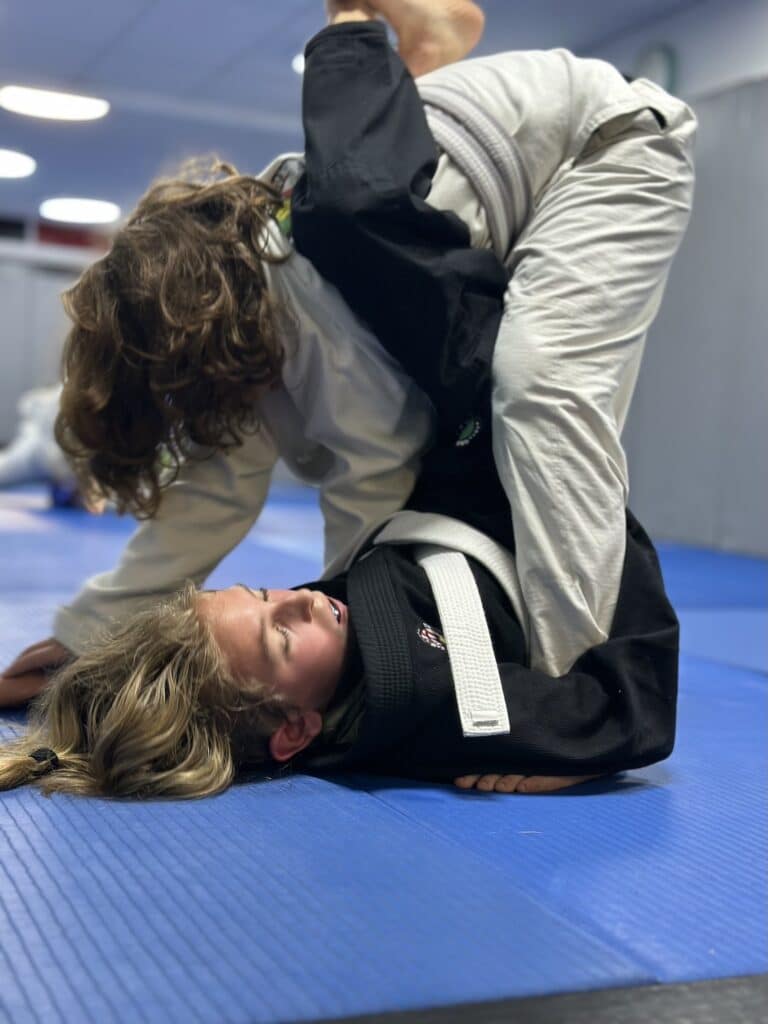
Screens win partly because most alternatives offered to kids are boring by comparison. Jiu-jitsu is not. A class is warm-ups that feel like games, a technique to figure out, drilling with a partner, and live practice where a child gets to test what they learned against real resistance. It uses the whole body — pushing, pulling, balancing, falling safely, getting up — and it scales: a six-year-old and an eleven-year-old are both working hard at their own level in the same room. Kids leave sweaty. That is not a small thing in a childhood that increasingly happens sitting down. The tiredness parents report after class is the honest kind, earned by muscles, and it makes the rest of the evening — including sleep — noticeably easier.
Friends who are not avatars
A lot of screen time is social time now — kids are in the game with their friends, and taking the game away can feel like taking the friends away. That is a fair concern, and it is why replacement beats removal. On the mats, your child trains with the same partners week after week. They drill together, struggle together, and get promoted together. The friendships that form here are the unhurried kind, built out of shared effort — and for many kids they become the friendships, the ones they ask about on the drive over. A screen friend disappears when the server closes. A training partner shows up on Tuesday and asks where you were on Thursday. Our guide to the after-school program walks through how the schedule fits a working family’s week.
Achievement that is not a high score
Games are engineered to hand out achievement — levels, badges, streaks — because achievement feels good and kids chase it. Jiu-jitsu hands out the real version, slower and worth more. A stripe is earned for attendance, attitude, and skill, in front of the whole room. A technique that failed for two weeks suddenly works on a bigger partner, and nobody has to tell the child it happened — they felt it. Kids who train develop a different relationship with hard things: effort first, result later, and the result is actually theirs. That mindset follows them off the mats — to homework, to music practice, to every other thing that does not come with a “skip” button. You can read more about how kids progress on our kids jiu-jitsu page.
Start with one evening
You do not need a family summit about screens. Just take one of the contested hours and put a class in it. The first class is free — a real group class with kids their age, no payment and no contract for a trial, and a free uniform if they enroll. Arrive about 15 minutes early in athletic clothes with a water bottle; you can watch from the side the whole time. If your child is 4 to 6, they start as a Little Grappler; teens 13 to 17 have their own class, because a fourteen-year-old is not a big kid. Send the free trial request or call (202) 636-3453. Keep the tablet. Just give the 5 PM hour some competition.
Your first class is free.
A real group class with your own group. No experience needed, no payment, no contract for a trial — and enrollment includes a free uniform.
1. Send the free-trial request or call (202) 636-3453.
2. We confirm the right class for your age and schedule.
3. Arrive 15 minutes early in athletic clothes with water.
4. Train a real class — then decide with zero pressure.
Screens, kids, and the mats, answered
Two or three is the rhythm most families settle into, and it is enough to anchor the week — class days have a shape, and the after-school gap gets filled on the days that used to be the worst. Once a week is a fine way to start. Consistency matters more than volume; a class that actually happens beats an ambitious schedule that collapses.
Expect it, and do not negotiate the trial — just bring them to watch or try once. The class is social and physical in a way that surprises kids who pictured something like school. Many of our most committed students arrived announcing they would hate it. Let the hour make the argument; it is better at it than either of us.
Exercise is part of it, but the difference is engagement. A child can drift through a soccer practice touching the ball four times. In jiu-jitsu, every minute is one-on-one problem solving against a partner — there is no standing around and no hiding. It holds attention the way a game does, because it is a physical game with a person across from you.
Kids ages 4 to 12 train in age groups at 5:00 PM, Monday through Friday, and Saturday has a 9:00 AM kids no-gi class. Ages 4 to 6 are our Little Grapplers. Teens 13 to 17 have their own dedicated class. Partners are matched by size and experience, and coaches are on the mats for the whole class.
Send the free-trial request or call (202) 636-3453, and we will confirm the right class for your child’s age. Arrive about 15 minutes early in comfortable athletic clothes with a water bottle — no uniform needed to try. Your child joins a real group class and you can watch the whole time. No payment, no contract for a trial, and the uniform is free if you enroll.