Self-Defense for Kids
More girls are choosing jiu-jitsu \u2014 and staying with it. Why the art fits, what a class actually looks like for your daughter, and how to let her judge it for herself.
Search ‘self-defense for kids’ and you will be offered a lot in a hurry: one-day seminars, secret techniques, gadgets, and programs that promise to make your child ‘bully-proof.’ It is an emotional purchase — every parent making it is really asking one question: if something ever went wrong, would my child know what to do? This guide gives the honest answer we give parents in Takoma Park. Some of what is sold to worried parents genuinely works, and some of it does not survive contact with a real playground, a real grab, or a real moment of panic. Here is how to tell the difference — what to look for, what to walk away from, and where Brazilian jiu-jitsu fits into the picture.
What works first is not fighting at all
The most useful self-defense a child owns is used long before anyone lays a hand on them. It is awareness: noticing who is around, trusting the uneasy feeling, and moving toward other people and populated places instead of away from them. It is voice: a loud, clear ‘Stop,’ ‘No,’ or ‘You’re not my parent’ that draws adult attention — practiced out loud, because a child who has only ever thought those words can freeze instead of saying them. And it is boundaries: knowing they are allowed to refuse, to leave, to tell a trusted adult, and to keep telling until someone acts. Our kids program puts it in that order on purpose — confidence, voice, and boundaries first, then physical escapes and control — because most real situations a child faces are ended by being seen, being heard, and getting to an adult, not by winning a fight.
The physical skills that actually hold up
When a situation does become physical, the skills that hold up for a child are simple, few, and practiced until they are reactions. Falling safely, so a push or a trip does not become an injury. Escaping the holds that actually happen — a wrist grab, a bear hug, being pinned to the ground. Creating space, getting back to their feet, and getting to safety and help. None of that depends on being bigger or stronger than the other person: escapes in jiu-jitsu work through leverage, frames, and timing, which is exactly why they suit a smaller child. The catch is how they are learned. A technique shown once, in a line, against a partner standing still, is a memory. A technique drilled every week against a partner who is genuinely — and safely — trying to hold on becomes a reaction. Under stress, children do not rise to the level of what they were shown; they fall to the level of what they have practiced.
What doesn’t work — however well it’s sold
Start with any promise of a guaranteed outcome. No honest program can make a child ‘bully-proof,’ just as no program can promise your child will come out ahead in a confrontation — and a school that guarantees either is selling you the feeling of safety rather than the thing itself. One-day seminars have the same problem in miniature: a child may enjoy one and learn a move or two, but a single afternoon cannot build a reaction that survives surprise and adrenaline. Choreographed sequences against a cooperating partner fail for the same reason — the other person never agreed to the script. And striking-first approaches ask the hardest thing of the smallest person: that a child out-hit someone bigger. Other arts teach striking well, in their own schools, but a small child’s realistic goal is almost never to win a fight. It is to break free, get upright, get loud, and get to help — and that is a different, more honest curriculum.
Where BJJ fits — and where its limits are
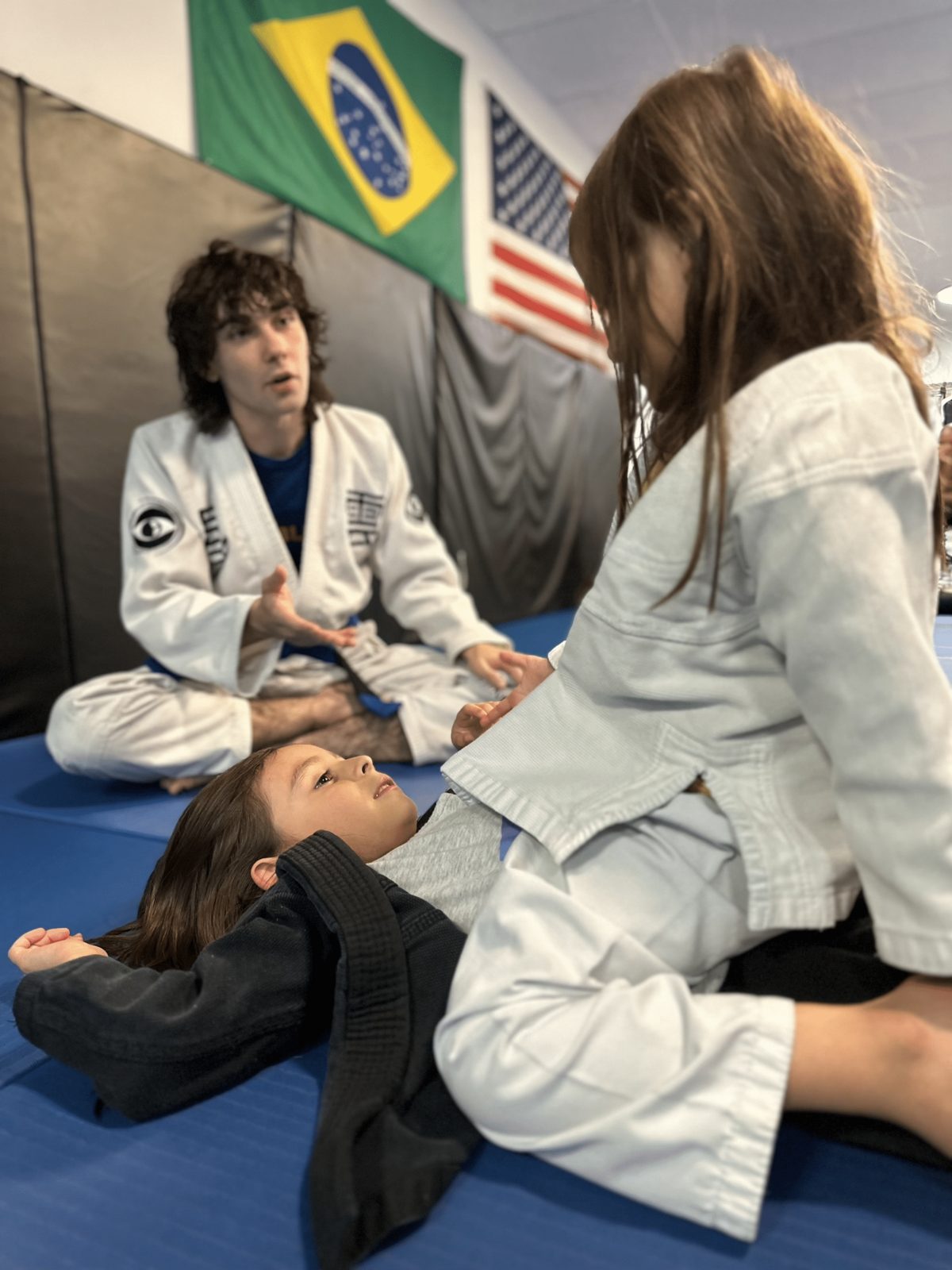
Brazilian jiu-jitsu fits that curriculum closely, which is why we teach self-defense as an outcome of regular training rather than as a separate, watered-down course — you can read how that works on our self-defense through BJJ page. There is no striking in BJJ at all. Children in our kids jiu-jitsu program learn to fall safely, escape from underneath, control a partner without hurting them, and stay calm while they do it, with partners matched by age and size and a coach choosing every pairing. Every child also learns the tap on day one — the signal that stops any exchange instantly — which teaches the other half of self-defense: that they are allowed to stop, and that stopping is respected. The limits deserve the same honesty. BJJ is not magic, it does not work in a week, and no mat skill replaces supervision, awareness, and trusted adults. We cover the safety side of training itself in is BJJ safe for kids?
How to judge any program — including ours
Whatever school you visit, ask five questions. Is the first lesson awareness, voice, and boundaries — or does it jump straight to fighting? Are the physical skills practiced live, against partners who actually resist a little, with a coach watching every pair? Can any child pause or stop an exchange at any time, and is that visibly respected? Does the program promise outcomes — ‘bully-proof,’ guaranteed confidence — or does it describe skills and let you watch them being built? And is it ongoing training, week after week, or a single event dressed as a solution? A good program answers all five in the room, in front of you, without needing to persuade you.
The honest way to judge any of this is one real class, watched with your own eyes. At WDC BJJ in Takoma Park, a child’s first class is free — a real group class with their own age group, no uniform, payment, or contract needed, and you watch from the side of the mat the whole time. Watch whether your child learns to use their voice, practices a real escape, and leaves knowing how to fall and how to stop. That tells you more than any brochure — ours included. Book a free class and see it for yourself.
Your first class is free.
A real group class with your own group. No experience needed, no payment, no contract for a trial — and enrollment includes a free uniform.
1. Send the free-trial request or call (202) 636-3453.
2. We confirm the right class for your age and schedule.
3. Arrive 15 minutes early in athletic clothes with water.
4. Train a real class — then decide with zero pressure.
Kids’ self-defense, answered
Awareness, voice, and boundaries — in that order. A child who notices a situation early, can shout a clear 'Stop' or 'You're not my parent,' and knows to get to a trusted adult and keep telling until someone acts has handled most real situations before they turn physical. The physical layer comes after: falling safely, escaping common grabs and pins, getting back to their feet, and getting to help. Programs that start with fighting techniques are teaching the last resort first.
No. Brazilian jiu-jitsu has no punching or kicking at all, and the goal taught in a kids class is the opposite of winning a fight: break free, get back to your feet, and get to safety and help. Children learn escapes and control — how to get out from underneath and hold a position without hurting a partner — practiced with partners matched by age and size, under a coach's supervision, with a tap that stops any exchange instantly.
No — and be wary of any program that promises it. No class can guarantee how a confrontation goes or how another child behaves. What regular training can honestly offer is practiced skills: a strong voice, clear boundaries, escapes drilled against resisting partners until they are reactions, and experience staying calm under pressure. That is real, and it is worth having — it just is not a guarantee, and a school that sells it as one is not being straight with you.
A seminar can be a fine introduction, but it is not training. Under surprise and stress, a child falls back on what they have practiced repeatedly, not on a technique they saw once in an afternoon. Skills like escaping a grab or falling safely become reactions only through regular practice against partners who genuinely try to hold on, at a controlled pace. Think of a seminar as a first look — the ability itself is built week by week.
At WDC BJJ, children start in their own age groups: the youngest train in Little Grapplers (ages 4–6), older kids train in their own group, and teenagers 13–17 have a group of their own. What changes with age is the depth of the technique, not the order of the lessons — voice, boundaries, and safe falling come first at every age, and every child learns the tap, the signal that stops any exchange, on day one.