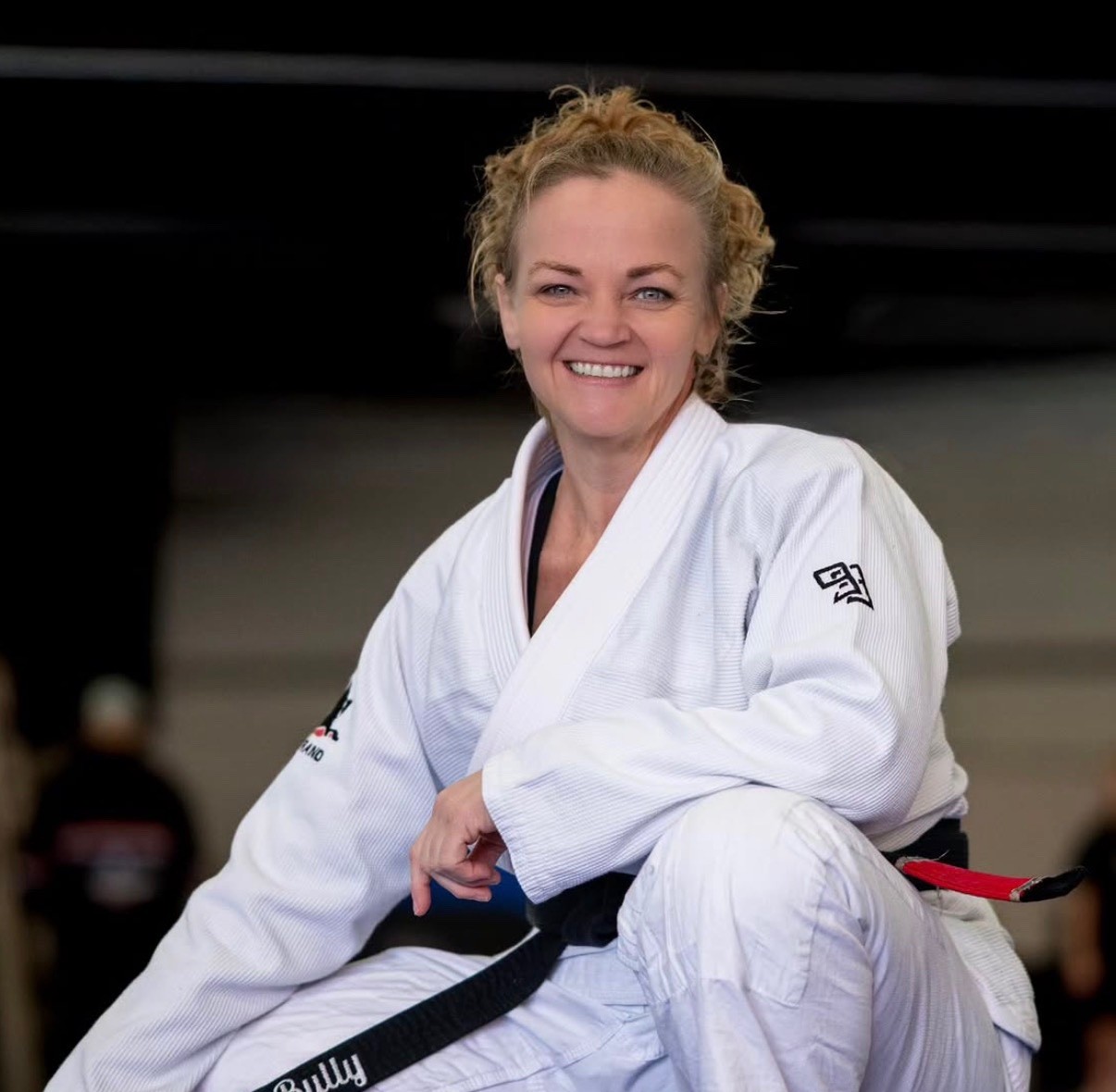
7 Self-Defense Principles Every Woman Should Know — From the Mat
Tips are easy to read and hard to use under stress. Principles are different: they organize everything. These seven come straight out of how we teach women’s jiu-jitsu — and the last one is the honest catch.
Most self-defense advice aimed at women is a list of tips: keys between your fingers, elbow is the strongest point, never wear a ponytail. Some of it is fine. Almost none of it survives contact with a real moment, because a frightening situation does not give you time to consult a list — it gives you whatever your habits are. That is why, in our women’s program at WDC BJJ in Takoma Park, we teach principles instead of tricks. A principle is a rule your body can follow under stress: keep distance, protect your neck, make frames, use leverage, get up. Below are the seven that matter most. Read them, keep them — and then read the honest seventh one twice, because it is the one that makes the other six real.
1. Awareness and distance come first
The best self-defense technique ever recorded is not being in the situation. Awareness is a skill, not paranoia: head up, phone down in transitional places — parking lots, stairwells, the walk from the door to the car — and early decisions made while they are still cheap. Cross the street early. Let the elevator go. Distance is the physical half of the same principle: an arm’s length of space is time, and time is options. On the mats we drill this as managing distance with your legs and frames, but it starts long before anyone touches you. A person who looks aware — eyes up, moving with purpose — is also, not coincidentally, a much less attractive target. Most trouble is opportunistic, and opportunists shop for distraction.
2. Your voice is a tool — use it early
A loud, clear voice does three jobs at once: it startles, it sets a boundary that cannot be misread, and it recruits everyone in earshot. “Stop. Get back.” — said like you mean it, at full volume — is not rude; it is the correct first technique, and it is one we literally practice in class, because most women have been trained by life to be quiet and polite in exactly the moments that call for volume. Practice matters here more than people expect. Saying it in a room, at full voice, twenty times, is what makes it available on the one night you need it. If you take one principle from this page and rehearse it in your car this week, take this one.
3. Frames and leverage beat strength
Here is the core physical idea of jiu-jitsu, and it is genuinely good news: you do not need to be stronger than someone to control what happens. Strength fades fast and size is not distributed fairly, but structure is available to everyone. A frame — your forearm or shin placed against a person’s body with your skeleton behind it — holds weight that your muscles never could. Leverage multiplies what you have: a hip used as a fulcrum moves a person your arms could not budge. This is why the art was built, historically, for the smaller fighter, and why our women’s classes spend so much time on frames and hip movement instead of anything resembling a punching contest. You are not trying to win a fight. You are building structure that a bigger person cannot simply collapse.
4. Protect the neck, fight for the inside
If a situation becomes physical, priorities simplify. Hands up and inside — between you and the other person — protects your neck and your face and puts your arms where they can frame, push, and control. Elbows stay close to your body, where they are strong, instead of flailing wide, where they are weak. Chokes and grabs are the realistic dangers in a close encounter, and both are answered by the same habits: chin down, hands inside, create space, improve your position one step at a time. It sounds calm written down. Making it calm in the moment is a training outcome, which is why these movements are drilled in every women’s class until they are boring — boring is what reliable looks like.
5. Know how to fall, escape, and get up
Most real encounters do not stay standing. They end up on the ground — the one place most people have never spent a single minute learning to be. Jiu-jitsu lives there. Our students learn to fall without injury, to escape from underneath a heavier person, to keep someone from holding them down, and — the skill that matters most — to get back to their feet safely, because standing is where leaving becomes possible. The goal of every ground technique we teach a beginner is the same: create space, get up, get away. Not to win. To leave. A woman who has practiced standing up from under a resisting partner two hundred times owns something no tip list can give her: the knowledge, in her body, that being on the ground is a problem with a solution, not the end of the story.
6. Train it — because tips don’t survive adrenaline
And here is the honest catch, principle six swallowing the whole list: reading is not training. Under adrenaline, people do not rise to the level of what they have read; they fall to the level of what they have practiced. Every principle above — voice, frames, escapes, getting up — becomes real only through repetition against partners who are actually resisting, in a room where it is safe to fail at it a hundred times. That is what our women’s classes are: Monday 6:00 PM no-gi, Wednesday 6:00 PM gi, and Saturday 11:00 AM gi, led by Professor Charlene, with partners matched thoughtfully and live practice always optional. Our post on women’s self-defense classes describes what those sessions actually teach, week to week.
Start with one class
You do not need to feel brave, fit, or ready — the women in that room started with the same article, the same questions, and the same nerves. Your first class is free: a real class, no payment and no contract for a trial, and a free uniform if you enroll. Arrive 15 minutes early in athletic clothes with a water bottle, and expect to be welcomed by name. Send the free trial request or call (202) 636-3453, and ask for a women’s class. Principles one through five fit on this page. Principle six is the one that makes them yours.
Your first class is free.
A real group class with your own group. No experience needed, no payment, no contract for a trial — and enrollment includes a free uniform.
1. Send the free-trial request or call (202) 636-3453.
2. We confirm the right class for your age and schedule.
3. Arrive 15 minutes early in athletic clothes with water.
4. Train a real class — then decide with zero pressure.
Women’s self-defense principles, answered
Yes — that is the entire premise of the art. Frames use your skeleton instead of your muscles, and leverage uses position instead of force. Beginners feel the difference in their first class, the first time a frame holds back a partner they could never have pushed away with strength alone.
Honestly: months of regular training, not a weekend seminar. Basics start working quickly — voice, distance, getting up — and deepen with every month of practice. Anyone who promises you reliable skills in a single afternoon is describing a product, not a capability. We would rather tell you the true timeline.
No. Live rounds are always offered, never required, and beginners start with cooperative drilling — a partner feeding you the position slowly while you learn the movement. When and whether you add live practice is your call, class by class, forever.
Women’s-only classes run Monday 6:00 PM (no-gi), Wednesday 6:00 PM (gi), and Saturday 11:00 AM (gi), led by Professor Charlene, who heads our women’s program. Mixed adult classes are also open to you whenever you want more training time.
Send the free-trial request or call (202) 636-3453 and ask for a women’s class. Arrive about 15 minutes early in athletic clothes with a water bottle — no uniform needed to try. You join a real class at your own pace, with no payment and no contract for a trial. If you enroll, the uniform is included free.