What Actually Happens in a Kids BJJ Class
Start to finish, exactly as it runs: what your child does from the moment they walk through the yellow building to the final bow — and what you will see from the side of the mat.
"Professor, what are we doing today?" It is the first thing out of most kids' mouths when they come through the door — and it is a fair question for parents, too. If you have never watched a kids jiu-jitsu class, it is hard to picture what fills the hour: is it wrestling? A lecture? Chaos in uniforms? At our academy in Takoma Park, a kids class follows the same arc every single time, on purpose — children settle when they know what comes next. Here is that arc, start to finish, exactly as you would see it from the side of the mat.
Through the yellow door: arrival and line-up
Kids come in through the yellow building — that is the children's entrance at 720 Erie Ave. Shoes off, bags down, water bottles on the shelf, and straight to the edge of the mat. Parents settle in to watch from the side; you are welcome to stay for the whole class, every class, and most parents of new students do. Arrive about fifteen minutes early on the first day — enough time for the waiver, a look around, and a word with the coach. When class is called, the kids line up, face the front, and bow in together. It takes half a minute, and it does real work: it is the moment the room switches from playground energy to class energy, and even the four-year-olds learn to make that switch.
Warm-up: movement before technique
Every class starts by moving. Kids run the mat, shrimp across the floor — the sideways hip escape that half of jiu-jitsu is built on — roll forward and backward, and practice falling safely: how to land, tuck, and protect the head and arms. For the youngest group, Little Grapplers (ages 4–6), this part stretches longer and turns into movement games, because at that age movement is the curriculum. In the kids classes (ages 7–10) the warm-up is shorter and sharper, but nobody skips it. Cold muscles and new movements do not mix, and the falling practice quietly becomes one of the most useful skills a child owns — it follows them to the playground, the bike, and every other sport.
Technique of the day: one idea, taught in steps
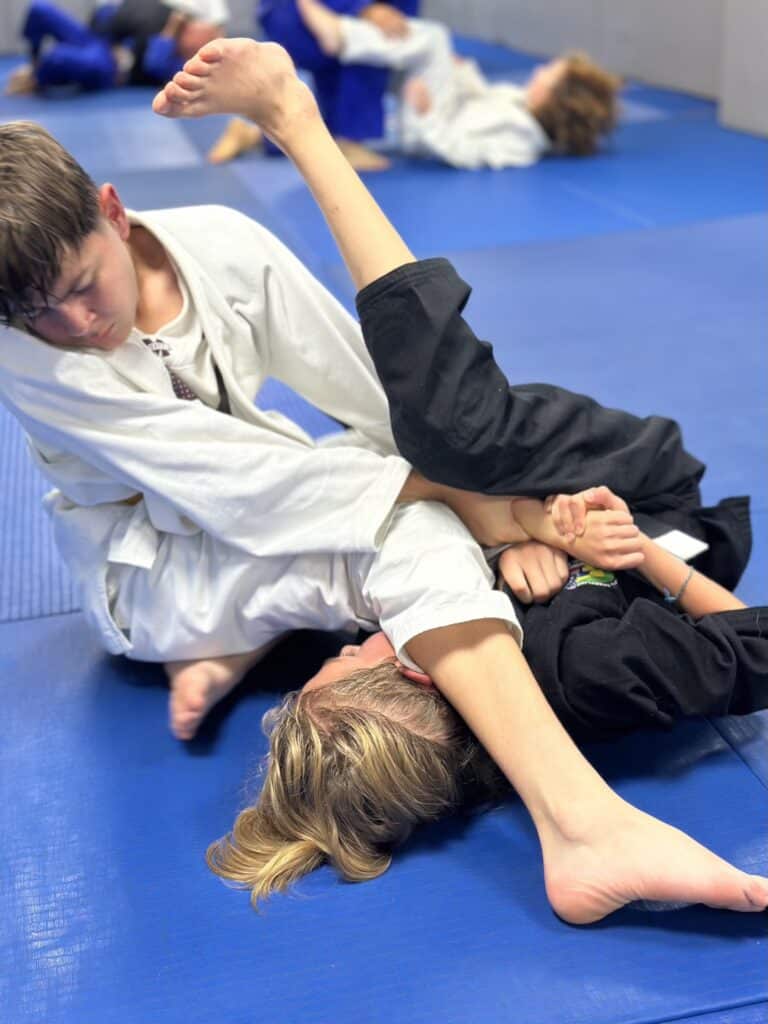
Then the class gathers around the coach for the technique of the day — one idea, not five. An escape from the bottom. A way to pass a partner's legs and settle on top. A sweep that turns the tables. The coach shows it slowly, in small steps, then once more at real speed so the kids see where it is going. Questions happen here, not mid-practice. After the demonstration, the coach pairs the children up — partners are chosen by the coach, matched by age and size, never left to chance — and the kids walk through the steps together while coaches move from pair to pair, fixing a grip here and a hip angle there. A child in their very first class learns a real technique, but at walking pace, with a partner their own size. That is the design, and it is the same design behind our whole kids jiu-jitsu program in Takoma Park.
Partner drilling: the reps where it starts to stick
After the slow walk-through comes drilling: the same movement repeated, a little smoother each time. Partners take turns, so every child learns both sides of the technique — how to do it, and how it feels when it is done to them. This is where the class gets its energy. Kids count reps, laugh, and help their partner find the step they missed. The rule that governs all of it is the tap: tap a partner, tap the mat, or say stop, and everything halts instantly. It is taught before any technique and respected without exception — which is what lets children practice real grappling with real confidence. If you want the deeper version of how that safety system works, our parents' guide to whether BJJ is safe for kids lays it out piece by piece.
Live training and games: putting it together
The last working block depends on the age in the room. In Little Grapplers, it is games built on real positions — stay on top while your partner tries to escape, hold the guard, keep your base — games in name, jiu-jitsu in every movement. In the kids classes (7–10), it is short, supervised live rounds, usually starting from the position the day's technique came from, so the new skill gets tested the same day it is learned. A new child is never thrown into live rounds on day one; coaches introduce them gradually, against partners the coach selects, and any child can sit a round out. This is the part parents usually watch closest — and it is usually the part that wins them over, because you can see what the earlier blocks built: kids solving problems with their bodies, at a pace a coach controls, stopping the instant anyone taps.
Bow out: how class ends
Class ends the way it began. The kids line up, straighten their gis, and the coach names what the class worked on and what comes next time — a small ritual that does a lot, because children leave knowing what they learned instead of just being tired. Then they bow out together, and it is shoes on, water bottles found, and back out through the yellow building. The whole visit fits inside the class hour — the same order, the same rhythm, every single time. That predictability is not an accident. It is why a nervous first-timer in week one is confidently leading the warm-up line a couple of months later.
What this looks like on your child's first day
If you are picturing your own child inside that arc, the first class is simply its easiest version: a real group class with their own age group, at walking pace, with you watching from the side the entire time. No uniform is needed — athletic clothes and a water bottle are enough — and if your child enrolls afterward, the uniform is included free. The fastest way to judge any of this is to watch one class happen. Book a free trial class, take a seat by the mat, and watch the whole arc — yellow door to final bow — with your own eyes.
Your first class is free.
A real group class with your own group. No experience needed, no payment, no contract for a trial — and enrollment includes a free uniform.
1. Send the free-trial request or call (202) 636-3453.
2. We confirm the right class for your age and schedule.
3. Arrive 15 minutes early in athletic clothes with water.
4. Train a real class — then decide with zero pressure.
A kids class, step by step
The class follows the same arc every time. Kids enter through the yellow building, line up, and bow in. A movement warm-up comes first — running the mat, rolls, and safe falling. Then the coach teaches the technique of the day step by step, children drill it with partners matched by age and size, and the last block is games built on real positions for the youngest group (Little Grapplers, ages 4–6) or short supervised live rounds for the kids classes (ages 7–10). Class closes with a line-up and a bow out. Parents are welcome to stay and watch the whole thing.
Kids classes at WDC BJJ run in one-hour blocks, and the whole visit — arriving, class, and heading out — fits inside that hour. The youngest children (Little Grapplers, ages 4–6) spend more of their hour on movement and games, while the kids classes (ages 7–10) spend more of it on technique, drilling, and supervised live practice.
Yes — parents are welcome to stay and watch every class, the whole class, from the side of the mat. Most parents of new students do exactly that, and we think it matters: you see how the coaches pair partners, how the tap rule is respected, and how your child is settling in, with nothing hidden.
Athletic clothes and a water bottle are all a first class needs — no uniform and no special gear. The trial is a real group class with your child's own age group. If your child enrolls afterward, a uniform is included free with enrollment.
No. A new child is never thrown into live rounds on day one. They learn the technique at walking pace with a partner their own size, and live practice is introduced gradually, when the coach judges them ready, against partners the coach selects. A child can also sit out a round at any time, and the tap or the word stop ends any drill instantly.