Your Child's First BJJ Class: What Actually Happens
Booking, check-in, the warm-up, one technique, partner practice, and the tapping-out rule — your child's first class, pictured in advance.
For most kids, the hardest part of a first jiu-jitsu class isn't the class. It's the unknown: a new room, new people, a sport they've never seen up close. Parents feel it too — you can't picture what your child will actually be asked to do, minute by minute, and that makes the decision harder than it should be.
So here is the whole thing, step by step, exactly as it happens at WDC BJJ in Takoma Park. No surprises, no glossing over the parts parents worry about. If you want the short version plus the common questions afterward, our First-Class Guide covers those too.
Step 1: Booking the free trial
It starts with a simple request — send the free-trial form or call (202) 636-3453 and tell us who is training and how old they are. We confirm the right class for your child's age group — Little Grapplers (4–6), Kids (7–12), or Teens (13–17) — and the day that fits your schedule. The trial is a real group class with our regular students, not a private demonstration, and no experience is needed. Most kids on our mats started as complete beginners.
Step 2: Arriving and checking in
Come to 720 Erie Ave, Takoma Park and arrive 15 minutes early. That buffer matters: it lets your child check in at the door, meet the team, see the room before class starts, and settle in instead of rushing straight onto the mats. A coach will know it's their first class, and your child will be introduced to the group they'll train with — their own age group, every time.
What to wear and bring
This part is genuinely simple. Your child wears comfortable athletic clothes with no pockets or zippers — the kind they'd wear to run around a playground — and brings a water bottle. That's the whole kit list for a first class. If your child later enrolls, enrollment includes a free uniform, so there's nothing else to buy to get started.
Step 3: The warm-up
Class opens with a warm-up done together with the group: running, rolls, shrimping, and other movement drills that teach kids how to move on the ground safely. For the youngest group, Little Grapplers, much of this looks like what it is — games and movement drills designed to build balance, coordination, and listening skills. Your child follows along at their own pace; coaches demonstrate everything before anyone is asked to do it.
Step 4: One technique, in small steps
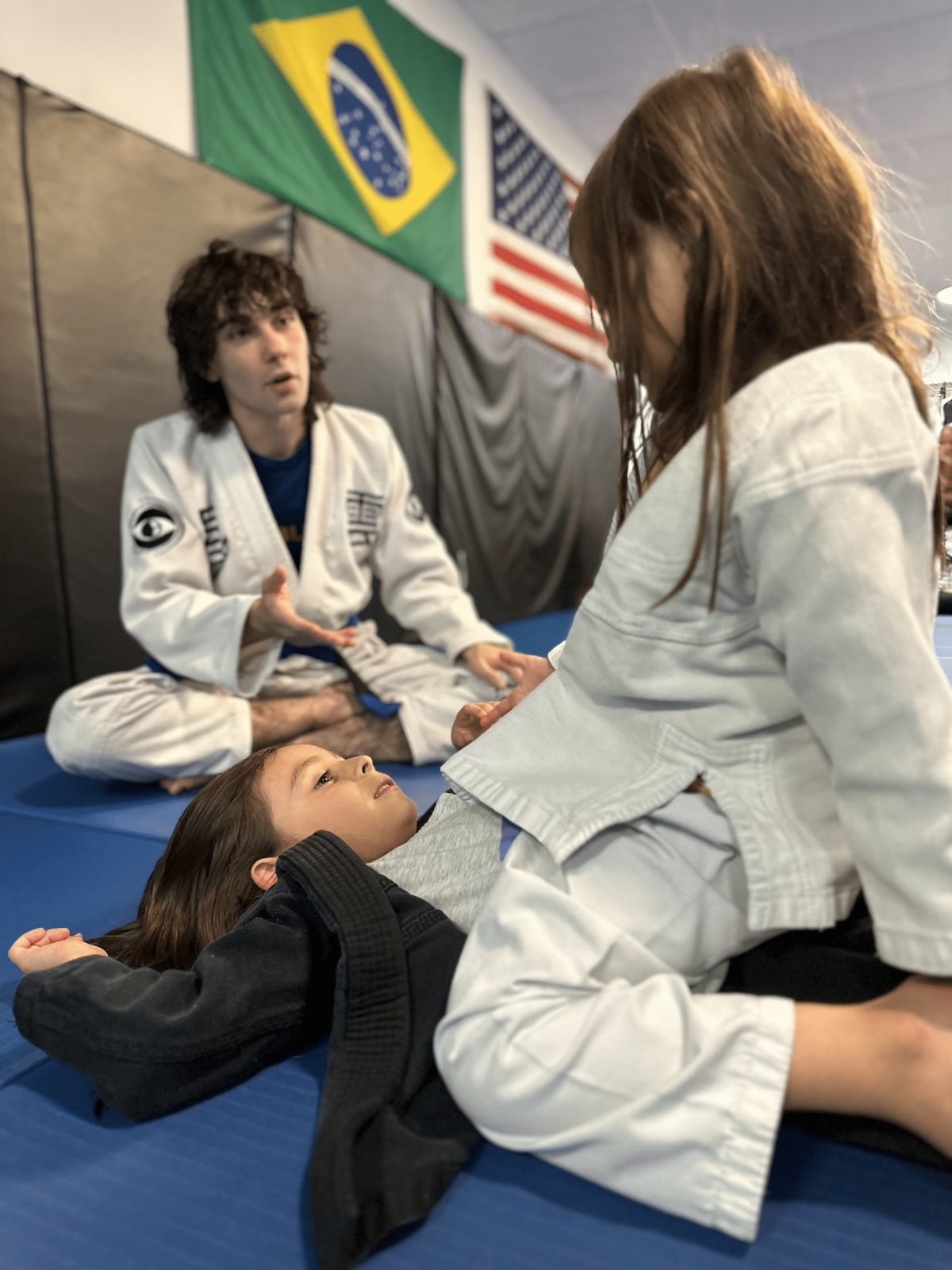
After the warm-up, the coach teaches one technique — a position, an escape, a movement — and breaks it into small, clear steps. The coach shows the whole thing first, then the class practices it piece by piece. The language is simple and the steps are short, because that's how kids actually learn. Your child will not be expected to remember a long sequence on day one; they will be expected to try the first step, and then the next one.
Step 5: Practicing with a partner
Then kids pair up with a partner of their own age and size and practice the technique on each other at a controlled pace. This is the heart of jiu-jitsu: learning by doing, against a real partner, with a coach on the floor watching every group. Nobody is thrown into anything. Beginners drill the steps they just learned, and coaches set the pace and step in whenever a pair needs help.
The tapping-out rule
Before any of this, your child learns the most important rule in the room: when anyone taps out, everything stops — instantly, every time. A tap is a hand slapped on the mat, the partner, or simply the words "tap" or "stop," and it ends the technique on the spot, no questions asked. Coaches teach it on day one and enforce it absolutely. It's what makes practicing a contact sport feel controlled and safe for a brand-new child.
Step 6: After class
When class ends, your child bows out with the group — and then it's your turn to ask questions. We'll answer anything you want to know: how the program works, which class fits your schedule, what the next step would look like. Options are explained only if you want them explained. There is zero pressure, and a trial involves no payment and no contract. Some families decide on the spot; plenty go home and think it over. Both are normal.
A word for shy and brand-new kids
If your child is shy, nervous, or has never done sports, they are the normal case here, not the exception. Nobody is asked to perform in front of the room on day one. Children join in at their own pace, coaches introduce everything step by step in simple language, and a quiet kid is allowed to be quiet while they find their footing. Most parents are surprised by how much of the class is simply moving, playing, and following along with the group — which is exactly why kids settle in faster than they expected.
That's the whole first class: book, arrive early, warm up, learn one thing, practice it safely, and go home with your questions answered. You can read more about the program itself on our Kids Jiu-Jitsu program page — or just come see it the way it actually happens, in a free trial class.
Your child's first class is free.
A real group class with their own age group. No experience needed, no payment, no contract for a trial — and enrollment includes a free uniform.
1. Send the free-trial request or call (202) 636-3453.
2. We confirm the right class for your child's age.
3. Arrive 15 minutes early in athletic clothes with water.
4. Train a real class — then decide with zero pressure.