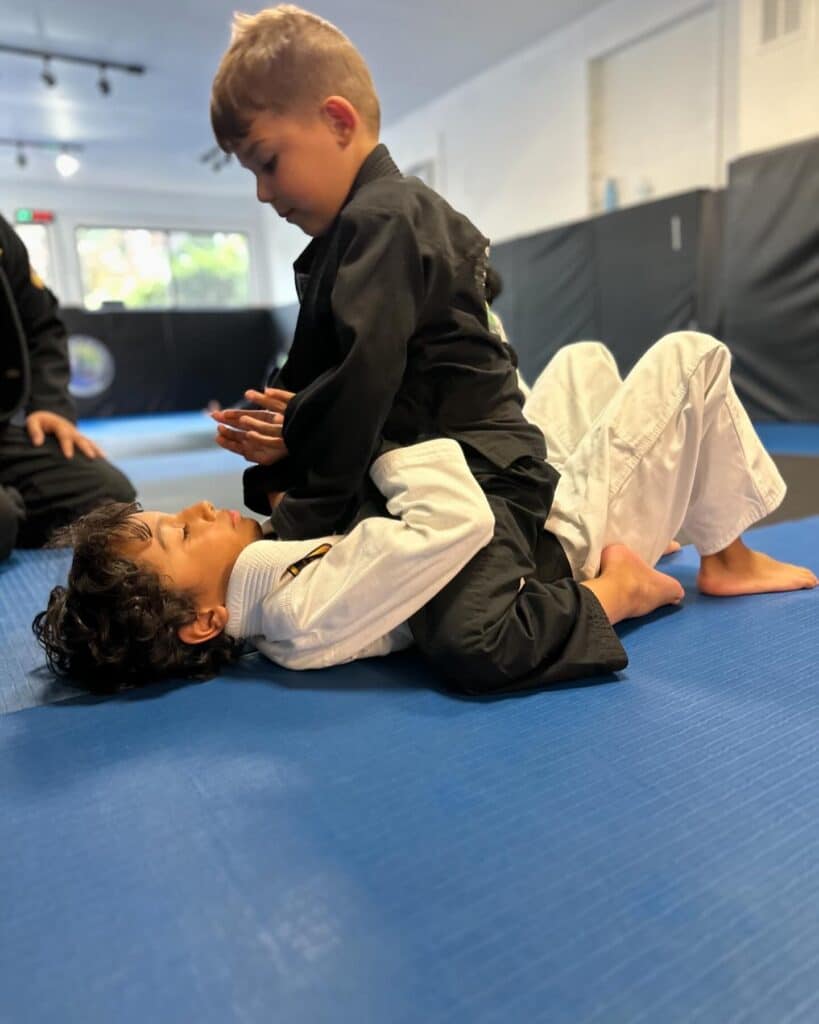
Is BJJ Safe for Kids?
It is the first question most parents ask — and it deserves a straight answer, not a sales pitch. Here is how safety actually works in a kids jiu-jitsu class, and how to judge it for yourself.
"Is it safe?" is usually the first real question a parent asks us. Your child would be grappling: holding, pinning, escaping, and learning to control a partner's body and protect their own. So here is the honest version of the answer: no physical activity is completely risk-free, jiu-jitsu included — but BJJ has safety built into how the art itself works, and a well-run kids class adds supervision, matching, and structure on top of that. What follows is how that system works, piece by piece, so you can judge any school — including ours — with your own eyes.
The short, honest answer
Brazilian jiu-jitsu is a grappling art: there is no punching, no kicking, and no striking at all. Children learn positions, control, and escapes — how to hold someone safely, how to get out from underneath, and how to fall without getting hurt. Safety in BJJ is not a promise a coach makes; it is a set of working rules: a stop signal every child controls, partners matched by age and size, practice that is supervised the whole time, and technique chosen for the age in the room. Those rules do not make bumps impossible — bumps are part of any active childhood, from the playground to the soccer field. They do make the training controlled, and control is what a parent should actually be looking for. Our kids jiu-jitsu program in Takoma Park is built around exactly those rules.
The tap: the rule taught before everything else
The first thing a child learns at WDC BJJ is not a technique. It is the tap — the signal that stops everything, instantly. Tap a partner, tap the mat, or say "stop," and the drill or the round is over, no questions, no teasing, no exceptions. Partners are taught to release the moment they feel it, and coaches reinforce it constantly. This matters more than any piece of equipment: it means your child is in control of their own body in every exchange, at every moment, from their very first class. A child who knows they can stop anything can relax, try, and learn — and a room where the tap is sacred is a room where children look out for each other.
No strikes, and falling is a skill
Because BJJ is grappling rather than striking, children are never learning to hit each other or be hit. The physical problem they solve is positional: how to stay balanced, how to escape a pin, how to use leverage instead of strength. And because grappling happens on the ground, falling safely is taught early and practiced often — how to land, roll, and protect your head and arms when you go down. It may be the most transferable skill in the program: a child who knows how to fall carries it to the playground, the bike, and every other sport. Coaches demonstrate every movement first, in simple steps, before children try it with a partner — nobody is asked to copy something they have only half seen.
Partners matched by age and size
Most of the risk in any children's contact activity comes from mismatches — a small beginner against a much bigger, more experienced child. A good school engineers those mismatches out. At WDC BJJ, the kids program serves ages 4–12 grouped by age and size: the youngest children train in Little Grapplers (ages 4–6), where the class is movement and games built around real positions, and teenagers 13–17 have a group of their own. Pairing within a class is the coach's job, not the children's — partners are chosen deliberately, and a new child is matched with someone their own size. When you visit a school, watch the pairings. They tell you more about safety than any brochure.
Supervision, structure — and no deep end
A kids class at our academy follows the same rhythm every time: warm-up and movement, the coach demonstrating one technique in small steps, supervised partner practice, then controlled mat time. New students are never thrown into live rounds on day one — live practice is introduced gradually, when the coach judges a child ready, against partners the coach selects. Parents watch from the side of the room, so nothing about this is hidden from you: you see how the coaches correct, how they pair, and how they handle the moment a child gets frustrated or wants to stop. If you want the full picture of that first visit before you come, our guide to your child's first BJJ class walks through it step by step.
What can still happen — the honest part
Here is what we will not do: promise you nothing can ever happen. In a supervised kids class, the realistic list is the ordinary one — a bumped knee, a bruise, sore muscles after a new movement, an occasional tear when a round does not go a child's way. Those are the same small costs as any active play, and pretending otherwise would not make them smaller. What the system above does is keep the training controlled, the intensity matched to the child, and an adult's eyes on every exchange — and it gives your child a stop signal that always works. Be wary of the opposite sales pitch, too: any school that guarantees zero injuries, for any activity, is telling you what you want to hear.
How to judge any school's safety yourself
You do not need to take our word for any of this — including about us. Watch one full class before you sign up anywhere, and look for five things. One: the coach demonstrates first, then watches every pair. Two: partners are matched by age and size. Three: the tap is taught by name and respected instantly. Four: the youngest kids are doing movement and games, not an adult class shrunk down — our age-by-age guide to starting BJJ shows what each stage should look like. Five: nobody rushes you to sign before you have watched. A school that runs a safe room is proud to have you watch it.
The fairest test is the same one we suggest for every question on this page: one real class. At WDC BJJ, the first class is free — a real group class with your child's own age group, no uniform, payment, or contract needed — and you watch from the side of the mat the entire time. Book a free class, watch how safety actually works in the room, and decide with your own eyes.
Your first class is free.
A real group class with your own group. No experience needed, no payment, no contract for a trial — and enrollment includes a free uniform.
1. Send the free-trial request or call (202) 636-3453.
2. We confirm the right class for your age and schedule.
3. Arrive 15 minutes early in athletic clothes with water.
4. Train a real class — then decide with zero pressure.
Safety, answered
No physical activity is completely risk-free, and any coach who promises zero risk is not being straight with you. What makes Brazilian jiu-jitsu manageable for children is how it is run: there is no striking, every drill can be stopped instantly with a tap, partners are matched by age and size, practice is supervised, and technique is age-appropriate. At WDC BJJ in Takoma Park, kids ages 4–12 train in groups matched by age and size, and parents can watch the whole class from the side of the mat.
The tap is the signal that stops everything — tapping a partner, the mat, or saying “stop” ends a drill or round immediately. It is taught on day one, before any real technique, and it is always respected, by partners and coaches alike. A child can tap at any time, for any reason, and no one questions it. It is the rule that puts your child in control of their own body in every exchange.
No. A new child is never thrown into live rounds on day one. Coaches demonstrate first, children practice the movement step by step with a partner their own size under supervision, and live practice is introduced gradually, when the coach judges a child ready for it. The free trial at WDC BJJ is a real group class, so you can watch exactly how that progression works before you decide anything.
By the coach, not by chance. Children are paired with partners of similar age and size — at WDC BJJ the kids program (ages 4–12) is grouped by age and size, the youngest children train in Little Grapplers (ages 4–6), and teenagers 13–17 have their own group. Partner selection is one of the main safety tools a school has, and it should be visible in any class you watch.
Watch a full class before you sign up anywhere. Look for a coach who demonstrates first and watches every pair, partners matched by age and size, a tap that is taught and respected, and youngest children doing movement and games rather than adult-style drilling. Ask who can stop a drill — the answer should be anyone, at any time. If you feel rushed to sign before you have watched a class, that itself is information.